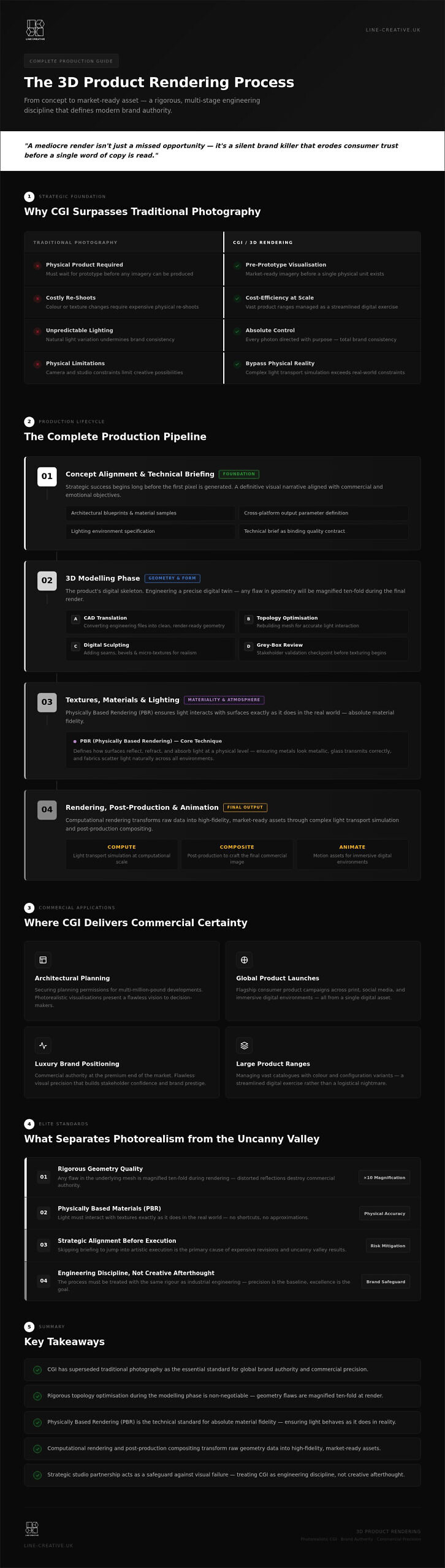
A mediocre render isn’t just a missed opportunity; it’s a silent brand killer that erodes consumer trust before a single word of copy is read. In a global market saturated with generic digital imagery, the 3D product rendering process must be treated as a rigorous, intentional, and uncompromising engineering discipline rather than a mere creative afterthought. You’ve likely experienced the frustration of navigating a sea of CGI providers who promise photorealism but deliver assets that fall squarely into the uncanny valley. It’s challenging to justify significant investment to stakeholders when the final output lacks the precision, weight, and commercial authority required for premium brand positioning.
This guide provides the definitive framework to master every technical and strategic stage of production, ensuring your assets command respect and drive measurable results. We will dismantle the complexities of the production lifecycle, from initial geometry to final compositing, to provide a clear roadmap for integrating elite CGI into your global marketing campaigns. You will gain the clarity needed to transform raw concepts into photorealistic assets that function as powerful, sophisticated, and reliable safeguards against visual failure.
Key Takeaways
- Understand why CGI has superseded traditional photography as the essential standard for global brand authority and commercial precision.
- Master the 3D product rendering process by translating raw CAD data into clean, render-ready geometry through rigorous topology optimisation.
- Implement Physically Based Rendering (PBR) to achieve absolute material fidelity, ensuring light interacts with textures exactly as it does in the real world.
- Recognise the critical role of computational rendering and post-production in transforming raw data into high-fidelity, market-ready assets.
- Discover how a strategic studio partnership safeguards your brand against visual failure through an uncompromising commitment to photorealistic excellence.
The Strategic Foundation: Defining the 3D Product Rendering Process in 2026
The 3D product rendering process is a multi-stage computational discipline that transforms digital geometry into high-fidelity, photorealistic marketing assets. It isn’t a mere creative “extra” but a rigorous methodology that defines modern brand authority. At its core, Rendering (computer graphics) involves complex light transport simulations that allow brands to bypass the limitations of physical reality. In the high-stakes world of global product launches, this process acts as an essential safeguard against visual failure. It ensures that every asset produced carries the weight, precision, and commercial authority required to influence high-level decision-making.
Precision is the baseline. Excellence is the goal. Whilst many providers treat this as a creative exercise, we recognise it as an engineering challenge that dictates the commercial viability of your next project. Jumping straight into artistic execution without strategic alignment is a recipe for expensive revisions and unrealistic results. The process must begin with a deep understanding of the stakes involved, whether you are seeking planning permissions for a multi-million-pound development or launching a flagship consumer product.
Concept Alignment and Technical Briefing
Strategic success begins long before the first pixel is generated. We start by establishing a definitive visual narrative that aligns with your emotional and commercial objectives. This phase involves gathering critical technical data: architectural blueprints, physical material samples, and specific lighting requirements. We define the output parameters for cross-platform implementation, ensuring assets remain consistent across print, social media, and immersive digital environments. Without this alignment, the risk of “uncanny valley” results increases exponentially. We treat your technical brief as a binding contract of quality.
Why CGI Surpasses Traditional Photography
Traditional photography is increasingly becoming a liability for complex, global brands. CGI offers unparalleled flexibility, allowing you to manipulate colours, textures, and lighting environments without the prohibitive costs of a physical re-shoot. The 3D product rendering process provides a level of control that physical cameras simply cannot match.
- Pre-prototype Visualisation: You can generate market-ready imagery before a single physical unit exists, accelerating your time-to-market; for those requiring physical prototypes alongside digital assets, VPrint3D Limited provides integrated rapid prototyping solutions.
- Cost-Efficiency at Scale: Managing vast product ranges or intricate architectural schemes becomes a streamlined digital exercise rather than a logistical nightmare.
- Absolute Control: Every photon is directed with purpose, eliminating the unpredictability of natural light and physical environments to maintain brand consistency.
The shift towards CGI as the primary standard for brand authority is driven by the need for risk mitigation. Whether it’s securing architectural planning permissions or launching a luxury product line, the ability to present a flawless, photorealistic vision is non-negotiable. Brands that leverage product launch CGI as a strategic tool can secure investor confidence and dominate competitive markets months before a physical product exists. It’s about more than just “pretty pictures”; it’s about commercial certainty in an overcrowded market.
Geometry and Form: The 3D Modelling Phase
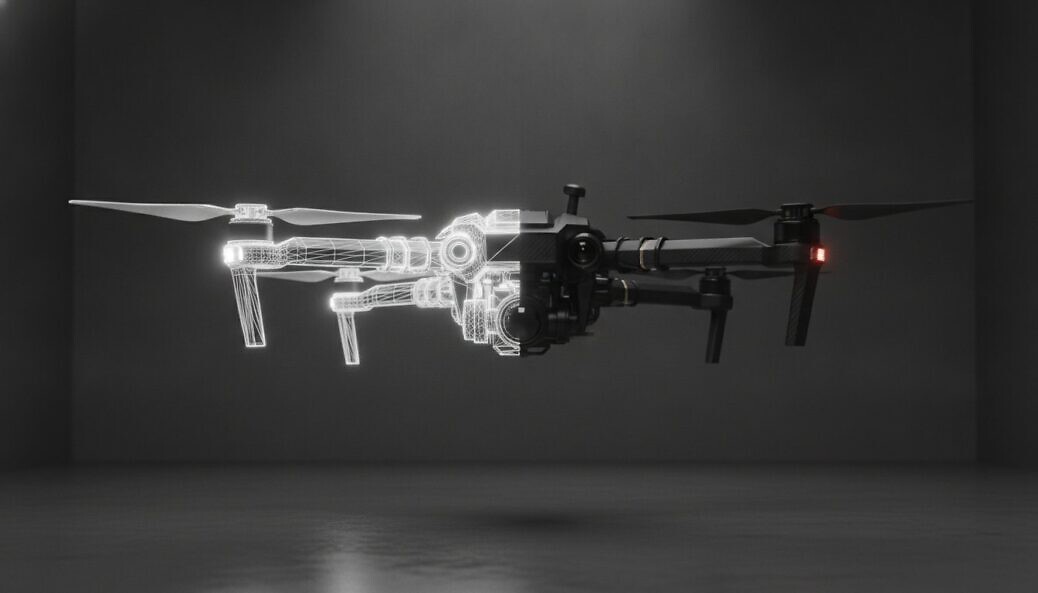
If the strategic foundation is the blueprint, then the modelling phase is the construction of the product’s digital skeleton. Within a professional 3D product rendering process, this stage is where abstract concepts gain physical weight and structural definition. We don’t merely “draw” a product; we engineer its digital twin with mathematical precision to ensure it behaves exactly like its real-world counterpart under simulated light. This phase is critical because any flaw in the underlying geometry will be magnified ten-fold during the final render, leading to distorted reflections and a loss of commercial authority.
Success in this stage requires a rigorous, four-step methodology:
- CAD Translation: Converting industrial engineering files or raw sketches into clean, precise, and render-ready 3D geometry.
- Topology Optimisation: Rebuilding the mesh to ensure a logical flow of polygons that facilitates accurate light interaction.
- Digital Sculpting: Adding the high-fidelity details that define realism, including seams, bevels, and micro-textures.
- Grey-Box Review: A vital stakeholder checkpoint where the untextured model is validated for structural accuracy and scale.
CAD Translation and Topology Optimisation
Industrial CAD files are built for manufacturing, not for visual excellence. They often arrive as a chaotic web of triangles that produce “pinched” surfaces and jagged shadows. Our team meticulously converts these files into a quad-dominant topology, which is essential for achieving the flawless surface reflections seen in premium product visualisation. Topology optimisation is the essential foundation for photorealistic light behaviour. Without this technical rigour, the product will never escape the “uncanny valley” of digital artifice.
Refinement and Structural Integrity
Realism lives in the details that the human eye expects but rarely consciously notices. We integrate micro-details such as subtle surface imperfections, rounded edges, and realistic assembly gaps. According to Adobe’s guide to 3D rendering, the way light catches a bevelled edge is a primary cue for the brain to register an object as “real”. This isn’t just about aesthetics; it’s about safeguarding the structural integrity of your brand. For architectural projects, we validate every digital model against original blueprints to ensure planning accuracy is never compromised. This meticulous approach transforms a simple digital file into a sophisticated asset that commands respect from stakeholders and consumers alike.
Materiality and Atmosphere: Textures and Lighting
Once the digital skeleton is validated, the 3D product rendering process moves from structural engineering to the simulation of physical reality. This is where we define the soul of the asset. We don’t simply apply colours; we layer sophisticated data through Physically Based Rendering (PBR) to ensure that light interacts with every surface exactly as it does in the physical world. This technical rigour is what separates a high-fidelity marketing asset from a generic digital sketch. It’s a precise calculation of physics that commands commercial authority.
Surface realism is the safeguard against the uncanny valley. If a texture feels “off”, the consumer’s brain immediately flags the image as a deception, eroding the trust you’ve worked hard to build. We treat materiality as a high-stakes component of your brand’s visual identity, ensuring that every fabric weave, metal grain, and stone vein is represented with absolute fidelity.
PBR Texturing and Surface Realism
Achieving absolute fidelity requires a granular approach to materiality. We define the albedo, roughness, and metallic maps with microscopic accuracy to control how light bounces, scatters, or absorbs. Whether we are simulating the cold, anisotropic reflections of brushed aluminium or the complex, multi-layered weave of carbon fibre, the goal is total believability. We deliberately integrate imperfection maps to break the digital perfection that often ruins realism. Subtle dust, microscopic scratches, and varied surface tension are the cues the human eye needs to accept an image as authentic.
Strategic Lighting and Environmental Context
Lighting is a strategic tool, not just a technical requirement. Within the 3D product rendering process, we design bespoke lighting environments that highlight your product’s unique selling points whilst maintaining a professional studio quality. We use three-point lighting to create depth and global illumination to simulate the complex way light bounces within a space. This is particularly vital in architectural visualisation, where the interplay of light and shadow dictates the emotional resonance of a room.
Placing the product within a lifestyle context or an architectural setting builds a narrative that resonates with your audience. We utilise HDRI (High Dynamic Range Imaging) to ground the product in a realistic environment, providing natural reflections and a sense of place. We carefully organise the scene to ensure the product remains the undisputed focal point amongst complex backgrounds. This meticulous control over atmosphere ensures your visual assets aren’t just seen; they are felt, creating a lasting psychological impact on the viewer. For design professionals looking to bring these visualisations into the real world, you can discover ArchKit Design and its innovative AR mobile application.
The Final Output: Rendering, Post-Production, and Animation
The 3D product rendering process reaches its technical zenith during the computational phase. Here, the software calculates millions of light rays as they interact with the geometry and materials defined in previous stages. It’s a high-stakes moment where technical precision meets raw processing power. Every bounce, reflection, and refraction is simulated to produce a high-fidelity image that commands commercial authority. This phase is the definitive bridge between technical preparation and commercial reality, ensuring that the final asset is flawless, persuasive, and precise.
Computational Rendering and Quality Control
Managing render times is a logistical challenge that requires significant hardware resources and meticulous planning. For complex architectural visualisations, we choose between CPU and GPU rendering based on the specific needs of the scene. CPU rendering offers stability for intricate light transport, whilst GPU rendering provides the speed necessary for rapid iteration and high-resolution output. We implement rigorous internal review protocols to catch technical glitches, material inconsistencies, or lighting artifacts before they reach the stakeholder. This quality control ensures every pixel aligns with your brand’s premium standards, acting as the ultimate safeguard against visual failure.
Post-Production and Dynamic Animation
Raw renders are rarely the final word in a professional workflow. Post-production is the ‘final polish’ where we use software like Photoshop or After Effects to enhance colour, contrast, and depth. This stage is where we perform sophisticated colour grading and compositing to ensure the final image feels cohesive, professional, and evocative. Post-production bridges the gap between digital calculation and cinematic beauty by refining the emotional resonance of the final asset. It transforms a technical output into a powerful piece of visual communication that resonates with the viewer’s psychology.
Static images are just the beginning of what is possible. The same high-fidelity 3D model used for stills can be transitioned into dynamic CGI animation for high-impact marketing. Whether it’s a sweeping architectural flythrough or a detailed product ‘explainer’ animation, motion adds a layer of engagement that static imagery cannot match. In a landscape where attention is the primary currency, these dynamic assets serve as a definitive solution to information overload. By leveraging the base model for multiple assets, we provide a cost-effective way to scale your global marketing campaigns without compromising on quality.
Partnering for Excellence: The Line Creative Methodology
A sophisticated 3D product rendering process is only as effective as the strategic mind directing it. At Line Creative, we don’t operate as a simple service provider; we function as a visionary partner and an essential safeguard against visual failure. Since our founding circa 2013, we’ve cultivated a methodology defined by uncompromising standards, technical rigour, and a deep understanding of market psychology. We recognise that for our global client base, a render is never just an image. It’s a critical asset designed to secure planning permissions, win investor confidence, or dominate a competitive consumer landscape. Precision is the baseline. Excellence is the goal.
Our approach is built on long-term stability and aesthetic perfection. We understand the gravity of the projects we handle, where a single inaccuracy in lighting or geometry can lead to significant commercial setbacks. By treating every project as a high-stakes collaboration, we ensure that the final output isn’t just photorealistic, but carries the commercial authority required to drive measurable results. We turn raw data into definitive, persuasive, and authoritative visual narratives.
A Collaborative Approach to High-End Visuals
Success in complex visualisation requires more than just technical skill; it demands total alignment with your design intent. Our team of specialists integrates directly with your internal design process to ensure every digital asset reflects your physical specifications with absolute precision. We employ methodical project management and transparent communication to handle large-scale schemes, ensuring that even the most intricate architectural visualisations remain on schedule and within scope. This level of integration allows us to catch potential discrepancies early, protecting your brand from the risks of the “uncanny valley” whilst maintaining a clean, uncluttered aesthetic. Discover our CGI animation and 3D rendering services to see how this collaborative rigour translates into world-class assets.
Global Standards in Architectural and Product CGI
The modern digital landscape is unforgiving. To command attention amongst a sea of information, your visuals must be beyond reproach. We leverage cutting-edge technology to create compelling content that resonates across international markets, transforming raw concepts into planning-ready and investor-ready visualisations. Our commitment to precision ensures that every asset functions as a definitive solution to the challenges of modern marketing. We don’t just aim for “good” results; we strive for aesthetic perfection that supports a strong commercial ROI. Every photon is directed with purpose. Every texture is crafted with intent. Contact Line Creative to discuss your next high-stakes visualisation project and secure the strategic partnership your brand deserves.
Commanding the Digital Landscape with Visual Precision
The path to market dominance requires more than just high-resolution imagery; it demands a 3D product rendering process rooted in technical precision and strategic intent. By mastering the transition from raw CAD data to photorealistic assets, you ensure your brand bypasses the uncanny valley to project absolute commercial authority. We’ve explored how rigorous topology, PBR materiality, and cinematic post-production work in unison to mitigate risk and accelerate stakeholder buy-in. These aren’t merely creative choices; they’re the definitive components of a framework designed for long-term commercial success.
As specialists in high-stakes architectural and product visualisation since 2013, Line Creative provides the essential safeguard your projects require. Our studio delivers photorealistic precision for global brands that refuse to compromise on quality or reliability. It’s time to move beyond generic CGI and embrace a methodology that protects your investment whilst elevating your brand’s narrative to its highest potential.
Secure your brand’s visual authority with Line Creative
Your vision deserves a framework that turns sophisticated concepts into an uncompromising reality.
Frequently Asked Questions
How long does the 3D product rendering process typically take?
The duration of the 3D product rendering process depends entirely on the complexity of the geometry and the required output resolution. Whilst a single studio packshot might be finalised within three to five working days, a comprehensive architectural visualisation or a detailed CGI animation can span several weeks. We establish clear milestones during the technical briefing to ensure your global marketing schedule remains undisturbed and every asset is delivered with uncompromising precision.
Is 3D rendering more expensive than traditional product photography?
Upfront investment in CGI often exceeds the cost of a single traditional photo shoot, but the long-term commercial ROI is significantly higher. You eliminate the logistical costs of shipping physical prototypes, hiring sets, and managing weather-dependent shoots. Once a digital twin is created, updating colours or textures is a streamlined process that avoids the prohibitive expense of a complete re-shoot, providing a versatile asset for years of marketing activity.
What files do I need to provide to start the rendering process?
We require technical design files such as CAD data in STEP, IGES, or OBJ formats or detailed architectural blueprints to ensure absolute structural accuracy. Supplementing these with material swatches, high-resolution reference photographs, or lighting mood boards allows our team to align the digital output with your brand’s physical reality. Clear technical documentation acts as the primary safeguard against visual inaccuracies and ensures the final asset commands respect.
Can you create renders for products that haven’t been manufactured yet?
Visualising unmanufactured products is one of the most powerful applications of our methodology. We transform raw design specifications and sketches into photorealistic assets, allowing you to secure investor buy-in or launch pre-order campaigns months before the physical product leaves the factory. This proactive approach to product launch CGI securing market authority accelerates your time-to-market and mitigates the risk of visual failure during critical launch windows by presenting a flawless, market-ready vision.
What is the difference between 3D modelling and 3D rendering?
3D modelling is the architectural phase where we construct the digital geometry and structural skeleton of the object with mathematical precision. In contrast, 3D rendering is the computational stage where software simulates light transport to apply materials, shadows, and textures to that geometry. Modelling dictates the form and structural integrity, whilst rendering dictates the final photorealistic appearance and the emotional resonance of the asset.
How do I ensure the final render matches my product’s exact materials?
We utilise Physically Based Rendering (PBR) workflows to match your product’s materials with microscopic precision. By defining specific values for albedo, roughness, and metallic properties based on your physical samples or technical spec sheets, we ensure the digital surface behaves exactly like the real-world material. This rigorous scientific approach guarantees that the 3D product rendering process results in an asset that carries the weight and authority your brand demands.
Can the 3D models used for stills be repurposed for CGI animation?
A high-fidelity 3D model is a versatile commercial asset that can be seamlessly repurposed for CGI animation. Once the initial geometry and materials are perfected for static renders, we can implement camera movement and dynamic lighting to create architectural flythroughs or product explainer videos. This multi-platform utility ensures you derive maximum value from a single strategic investment, allowing you to scale your campaigns across different media without compromising on quality.
Why is post-production necessary in the 3D rendering workflow?
Post-production is the essential final polish that bridges the gap between raw digital calculation and cinematic excellence. We use this stage to perform sophisticated colour grading, contrast adjustment, and compositing that software calculations alone cannot replicate. It ensures the final asset feels cohesive, professional, and evocative, providing the emotional depth required to influence high-level consumer decision-making and secure your brand’s visual authority.