Is your vision actually being heard, or is it merely being seen? In a market defined by digital noise, the difference between a project that stalls and one that succeeds often lies in the absolute clarity of its communication. You know that stakeholders are currently battling unprecedented information overload. They don’t just need to see a space; they need to believe in its commercial future and emotional resonance. High-end interior architectural visualisation is no longer a luxury deliverable. It’s an essential strategic safeguard that de-risks investment for complex, high-value schemes.
We recognise the immense pressure of communicating intricate spatial narratives whilst facing the constant threat of planning delays. This guide reveals how sophisticated CGI transforms these complex architectural stories into photorealistic realities that secure investment and accelerate property sales. You’ll discover how to leverage disruptive technologies to win planning permission with ease, attract pre-build capital, and differentiate your brand as a visionary leader in a saturated global market.
Key Takeaways
- Recognise the shift from static imagery to strategic storytelling, ensuring your project narrative resonates with high-level decision-makers.
- Master the technical nuances of interior architectural visualisation, where photorealistic light behaviour and material precision transform abstract designs into undeniable commercial reality.
- Leverage cinematic CGI as a powerful de-risking tool to attract pre-construction investment and secure planning permission for complex mixed-use schemes.
- Evaluate potential partners based on their ability to provide strategic insight and global authority rather than focusing solely on production costs.
- Maximise your project’s market differentiation by integrating disruptive technologies that create immersive, narrative-driven experiences for prospective buyers.
The Strategic Evolution of Interior Architectural Visualisation
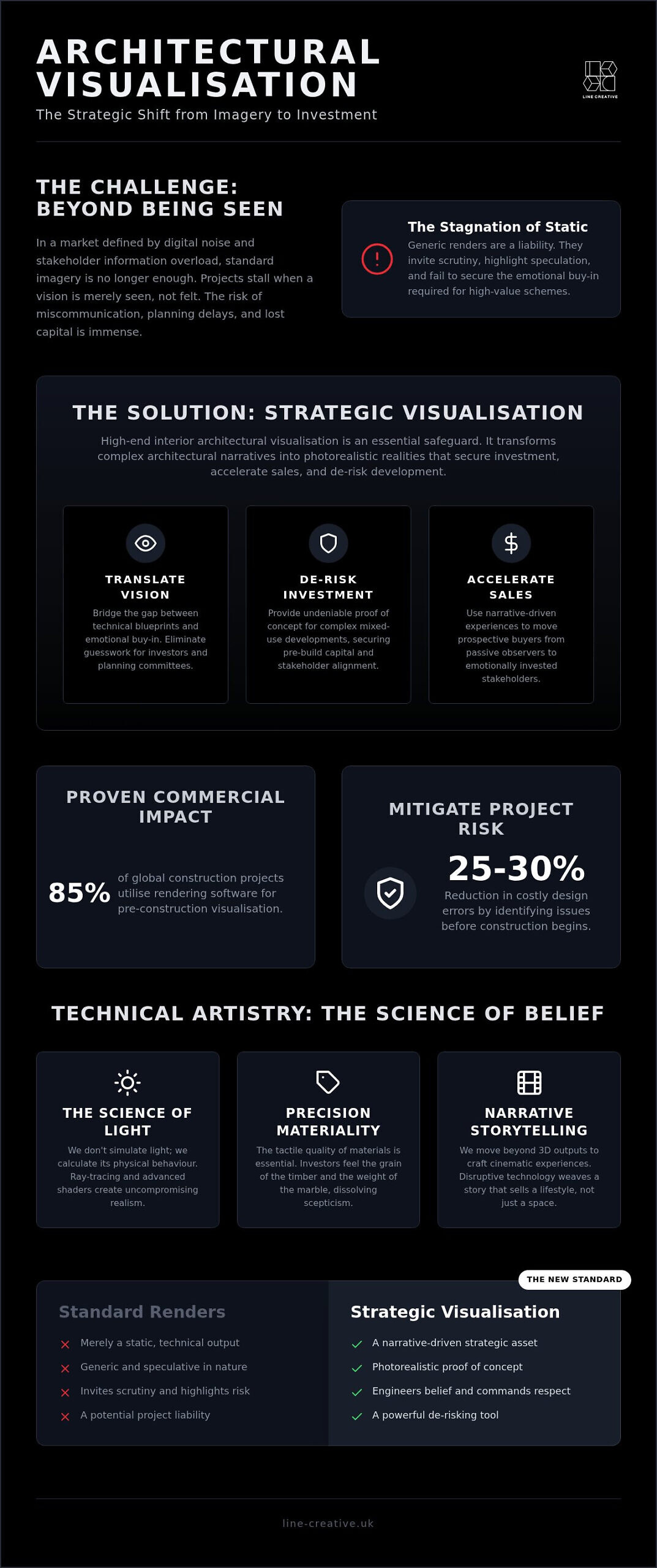
Interior architectural visualisation has evolved far beyond its roots as a simple technical output. It’s now a sophisticated blend of technical precision and strategic storytelling. In the current global property market, static images are no longer sufficient to secure a competitive edge. High-stakes marketing requires immersive, narrative-driven digital assets that don’t just show a room; they sell a lifestyle, a purpose, and a return on investment. Static is stagnant. Narrative is the new standard for commercial success.
This emphasis on narrative-driven experience is comparable to the atmospheric world-building found in modern gothic horror novels, where the setting itself creates a powerful psychological impact on the audience.
Standard CGI often lacks the gravity required for premium developments. When stakeholders review a proposal, they aren’t looking for a generic representation. They’re looking for proof of concept. The psychological impact of photorealistic imagery is profound. It bypasses analytical hesitation and speaks directly to the investor’s desire for excellence. Whilst the Architectural Illustration Overview provides context for the field’s history, modern high-value schemes demand a more aggressive and precise approach to digital creation. You need imagery that commands respect and projects reliability from the first glance.
Bridging the Gap Between Concept and Commercial Reality
Visualisation translates complex architectural intent into a language that investors and planning committees immediately understand. It removes the guesswork from technical drawings. By presenting a finished reality before a single brick is laid, you eliminate the friction of uncertainty. This clarity is vital for securing planning permission without the usual cycle of revisions and delays. Interior architectural visualisation serves as the definitive bridge between technical blueprints and emotional buy-in; it translates speculative data into a visceral, lived experience. A comprehensive visual strategy should also consider how exterior architectural visualisation works in tandem with interior assets to present a complete and compelling narrative to planning committees and investors alike.
This process of building a miniature, believable world is not unique to CGI; designers often use physical tools like 3D landscape stickers and scene-building sets to explore spatial narratives, and you can read more about KreativeWall’s miniature world-building stickers to see how they aid this creative process.
De-risking High-Value Mixed-Use Developments
Multi-faceted, large-scale projects present unique communication challenges. You must harmonise diverse spatial functions, from luxury residential units to commercial hubs, within a single, cohesive narrative. Miscommunication at this stage leads to delays, revised plans, and lost capital. As a specialist studio providing architectural rendering in London, we use disruptive technology to ensure every stakeholder sees the same vision. This alignment is the essential safeguard against the project stalls that plague less prepared developments. We provide the clarity and aesthetic perfection required to move from planning to construction with absolute confidence.
Technical Artistry: Where Photorealism Meets Emotional Resonance
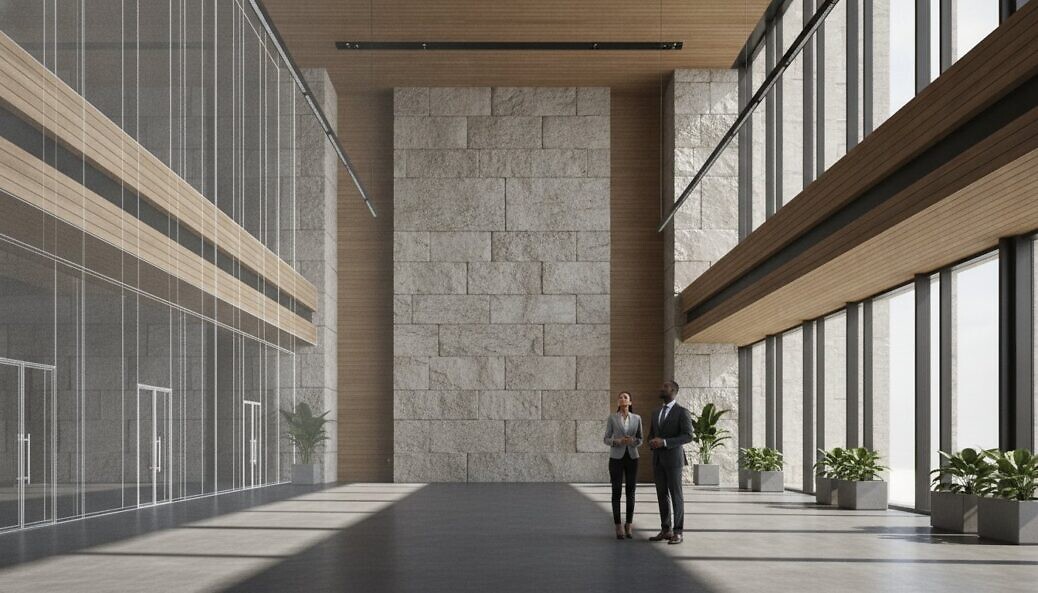
True photorealism isn’t a stylistic choice. It’s a commercial requirement. For high-value schemes, interior architectural visualisation must achieve a level of “real visual life” that feels indistinguishable from reality. Standard renders are a liability; they invite scrutiny and highlight the speculative nature of a project. We move beyond basic 3D outputs to craft cinematic experiences that engineer belief. This process requires an uncompromising approach to technical precision, where the physics of light and the tactile reality of materials are perfectly replicated.
Details define the brand. In luxury developments, bespoke furniture and curated lighting are not mere props; they are essential signatures of quality. For developers who wish to refine these interior specifications further, you can visit Neil Norton Design to learn more about their professional consultation services for residential projects. By meticulously modelling these elements, we ensure the visualisation reflects the exact brand identity intended for the scheme. This level of curated detail influences the behaviour of potential buyers, moving them from passive observers to emotionally invested stakeholders. In 2025, over 85% of residential and commercial construction projects globally utilised rendering software for pre-construction visualisation, which has been shown to cut design errors by 25 to 30%. Accuracy is your greatest safeguard against failure.
The Science of Light and Materiality
Ray-tracing and advanced shaders are the foundations of uncompromising realism amongst complex interiors. We don’t just simulate light; we calculate its behaviour as it interacts with diverse surfaces. The significance of texture and tactile quality in luxury residential visualisations cannot be overstated. When an investor can almost feel the grain of the timber or the cold weight of the marble—hallmarks of the ultra-luxury environments designed by Beverly Hills Luxury Interiors—their scepticism dissolves. Technical precision isn’t just about aesthetics; it’s about providing the certainty required to sign off on multi-million pound investments.
Narrative Storytelling through Disruptive Technology
We use disruptive technology to weave a narrative that standard CGI simply cannot match. The industry is moving rapidly toward real-time rendering and interactive walkthroughs, allowing stakeholders to inhabit a space before it exists. This immersive approach allows you to influence buyer behaviour by placing them at the centre of the story. Integrating our Virtual Production and VR services transforms a static pitch into a persuasive, lived experience that demands a response. You can explore our portfolio of high-value CGI projects to see how these technical principles translate into commercial success.
A Framework for Selecting a Specialist Visualisation Partner
Selecting a studio for high-end interior architectural visualisation is a strategic decision that directly impacts your project’s risk profile. Property developers often make the mistake of treating CGI as a commodity, yet the cost of poor visual communication far outweighs the savings of a cheaper vendor. A true partner provides the essential safeguard against stakeholder confusion and investment hesitation. You need a studio that possesses the creative flair to tell a story and the disruptive technology to make that story undeniable. Price is a poor proxy for value when millions in investment are at stake.
Authority is built on a foundation of proven success amongst diverse, high-value projects. An international portfolio is not merely a badge of reach; it is evidence that a studio understands global aesthetic standards and can navigate the complexities of multi-faceted mixed-use schemes. You are not looking for a helper. You are looking for a visionary who understands the psychological impact of imagery on decision-making and can leverage that understanding to secure your commercial objectives. Understanding the full scope of architectural visualisation services available in 2026 is essential to making an informed strategic choice for your development.
Assessing Technical Capability and Innovation
When evaluating technical innovation, you must look beyond the final render. Ask potential partners about their integration of real-time engines and CGI animation into their workflow. Are they merely producing static frames, or are they building immersive environments that allow for interactive exploration? A strategic creative partner will interrogate your brief to find the narrative heart of the development, whilst a vendor will simply replicate the blueprints. Award-winning status serves as an objective marker of industry validation, confirming that a studio’s output meets the highest global standards of excellence.
Analysing Portfolio Depth for Complex Schemes
Portfolio depth is the ultimate proof of capability for complex, mixed-use developments. When reviewing interior renders, pay close attention to the narrative flow and the nuance of lighting; these are the elements that create “real visual life” and differentiate a brand in a saturated market. It is also vital that your chosen studio understands the specificities of British architectural standards and the sensitivities of local planning committees. You can review the Line Creative Portfolio to see how we have successfully navigated these complexities for international developers. If you are ready to elevate your next scheme with a strategic partner, contact our London studio today to discuss your project requirements.
Maximising Commercial Impact and Investment Readiness
The commercial success of a high-value scheme depends on the speed of capital return. High-end interior architectural visualisation is the engine that drives this momentum. It doesn’t just present a space; it validates a financial future. For UK-based developers, attracting international investment requires more than just spreadsheets; it demands a visual proof of concept that translates across cultures and markets. By positioning your visual assets at the heart of a disruptive digital campaign, you command attention in a saturated market where attention is the most valuable currency.
Brand authority is built on the consistency of excellence. When your marketing materials reflect the same level of sophistication as the physical development—integrating high-end finishes and the professional video conferencing systems provided by AVI Plus—you eliminate the cognitive dissonance that often stalls luxury sales. We don’t view CGI as a secondary marketing expense. It’s the primary vehicle for building trust amongst a global audience of high-net-worth individuals and institutional investors. In an era of information overload, clarity is the ultimate competitive advantage.
Accelerating Sales and Securing Investment
The ROI of photorealistic interiors is measurable in the reduction of the sales cycle. Off-plan marketing strategies depend entirely on the viewer’s ability to inhabit a space mentally before it exists. Compelling visuals bridge the gap between a technical design and a sold property by providing “real visual life” that triggers an emotional commitment. This is particularly critical for luxury residential units, where the decision to purchase is as much about prestige and lifestyle as it is about square footage; here, the design influence of firms like Pianta Design becomes a vital component of the marketing narrative. By early 2026, 64% of architecture and design professionals had already experimented with AI-enhanced tools to speed up these workflows, yet the demand for bespoke, artist-led precision remains the benchmark for high-value schemes.
The Future of Visual Communication in Architecture
The industry is rapidly approaching a total shift towards fully immersive, real-time interior environments. By late 2026, we predict that interactive walkthroughs will be the baseline expectation for any major development pitch. Static images will serve as invitations, but the real work of securing investment will happen within real-time engines that allow stakeholders to customise and explore every detail. Pairing this with a robust exterior architectural visualisation strategy ensures that every dimension of a high-value scheme is communicated with equal authority and precision. We apply disruptive technologies to ensure our clients stay ahead of this curve, providing the stability and innovation required to dominate the digital landscape. To secure your project’s commercial future, contact Line Creative to discuss your next high-value scheme and discover how we transform complex narratives into photorealistic reality.
Defining the Future of Your High-Value Scheme
The transition from speculative blueprints to commercial success requires more than just technical skill; it demands a strategic vision that commands respect. High-end interior architectural visualisation acts as the definitive safeguard for your project, ensuring that every stakeholder, investor, and planning committee sees the same uncompromising reality. You’ve seen how photorealistic light behaviour, material precision, and narrative depth dissolve scepticism, whilst cinematic assets build the emotional resonance necessary to secure off-plan sales.
Success in a saturated global market depends on your ability to differentiate your brand through clarity, stability, and innovation. As an award-winning international CGI studio, we specialise in the visual communication of complex, high-value schemes. We’re trusted by global architects and developers to transform architectural intent into “real visual life” that drives investment. The stakes are too high for standard renders that don’t command authority. It’s time to leverage disruptive technology to secure your commercial objectives and lead the industry’s next phase.
Secure your project’s success with Line Creative’s award-winning CGI
Your vision deserves the clarity and excellence that only a strategic partner can provide.
Frequently Asked Questions
What is the difference between standard CGI and high-end interior architectural visualisation?
Standard CGI is often a technical commodity focused on basic representation, whilst high-end interior architectural visualisation is a strategic narrative tool. It prioritises photorealistic accuracy, cinematic storytelling, and emotional resonance to engineer belief in a project’s future. By utilising disruptive technology, we ensure uncompromising realism that de-risks investments for high-value schemes, moving beyond simple 3D outputs to create assets that command authority and drive commercial success.
How does interior visualisation support planning applications for mixed-use schemes?
Visualisation translates complex architectural intent into a clear, visceral language that planning committees and local authorities immediately understand. It harmonises diverse spatial functions within a single, cohesive narrative, providing the clarity needed to secure permission for multi-faceted developments. This process removes the friction of uncertainty, acting as the essential bridge between technical blueprints and the emotional buy-in required to move a project forward with confidence.
Can 3D interior rendering help in securing pre-build investment?
Yes, 3D interior rendering is a critical component in attracting pre-build capital and international investment for UK-based schemes. It provides the “real visual life” that allows investors to inhabit a space mentally before construction begins. This visceral experience reduces the sales cycle and provides the definitive proof of concept needed to validate a project’s commercial future, ensuring that your development stands out in a saturated global market.
What technical information is required to start an interior visualisation project?
We require technical blueprints, CAD drawings, and comprehensive material specifications to begin the process. To achieve the highest standards of interior architectural visualisation, we also need details regarding bespoke furniture, lighting schedules, and brand identity guidelines; for instance, you can discover Living Chic for a wide range of stylish furniture and homeware that can help define a project’s aesthetic. This foundation of technical precision ensures that the final digital assets are an exact, photorealistic replication of your intended design, leaving no room for stakeholder scepticism or misinterpretation.
How long does it typically take to produce photorealistic interior renders for a large project?
Production timelines depend on project complexity, but a high-quality, artist-led render typically requires two to four weeks to reach completion. Large-scale projects involving animation or interactive walkthroughs often demand longer lead times to ensure technical perfection. We prioritise a methodical and rigorous approach to ensure every detail meets our award-winning standards, providing the stability and quality required for high-stakes property marketing and investment pitches.
Is real-time rendering or VR necessary for every interior visualisation project?
Whilst not strictly mandatory for every project, real-time rendering and VR are rapidly becoming the industry standard for high-stakes pitches. These disruptive technologies provide an immersive, lived experience that static images simply cannot match. We recommend these tools for complex mixed-use schemes where stakeholder engagement and investment security are the primary objectives, as they allow for a deeper level of interactive exploration and narrative impact.