A technically flawless master-plan is a dangerous strategic liability if planning committees and institutional investors cannot instantly grasp its real-world impact. When visionary civic spaces remain trapped beneath two-dimensional CAD drawings and dense engineering specifications, decisions stall and vital capital hesitates. High-impact landscape visualisation CGI bridges this critical divide, translating complex civil schemes into precise, persuasive, and emotive visual narratives that command commercial authority from day one.
You recognise the intense friction of presenting sensitive, large-scale sites to sceptical planning authorities, particularly when generic architectural renders fail to communicate environmental harmony, communal value, or true scale. It’s a costly disconnect that leaves ambitious developments vulnerable to delay. In this guide, you will discover how landscape visualisation CGI eliminates technical information overload, de-risks the statutory approvals process, and secures decisive international investment. We examine how real-time rendering pipelines, procedural terrain systems, and ISO 19650 BIM standards unite to transform ambitious schemes into bankable built-environment assets.
Key Takeaways
- Discover how landscape visualisation CGI transforms complex master-planning into persuasive narratives that de-risk statutory planning approval.
- Understand why simulating organic environmental complexity and subtle atmospheric lighting requires specialised workflows beyond standard architectural visualisations.
- Learn how photorealistic CG visuals function as a strategic asset to attract institutional investment and articulate long-term commercial value.
- Identify proven methods to establish visual authority, dismantling committee scepticism and bridging the imagination gap across sensitive sites.
What is Landscape Visualisation CGI in a High-Stakes Context?
In high-stakes master-planning, outdoor visual imagery can no longer exist as decorative background filler. Landscape visualisation CGI is the deliberate synthesis of architectural precision, horticultural authenticity, and naturalistic artistry. Built on advanced 3D computer graphics workflows, modern CGI architectural visualisation translates complex grading, water management, and planting strategies into compelling, defensible spatial environments. Rather than presenting isolated structures, strategic imagery integrates built assets seamlessly into their contextual surroundings, safeguarding developments from early regulatory pushback.
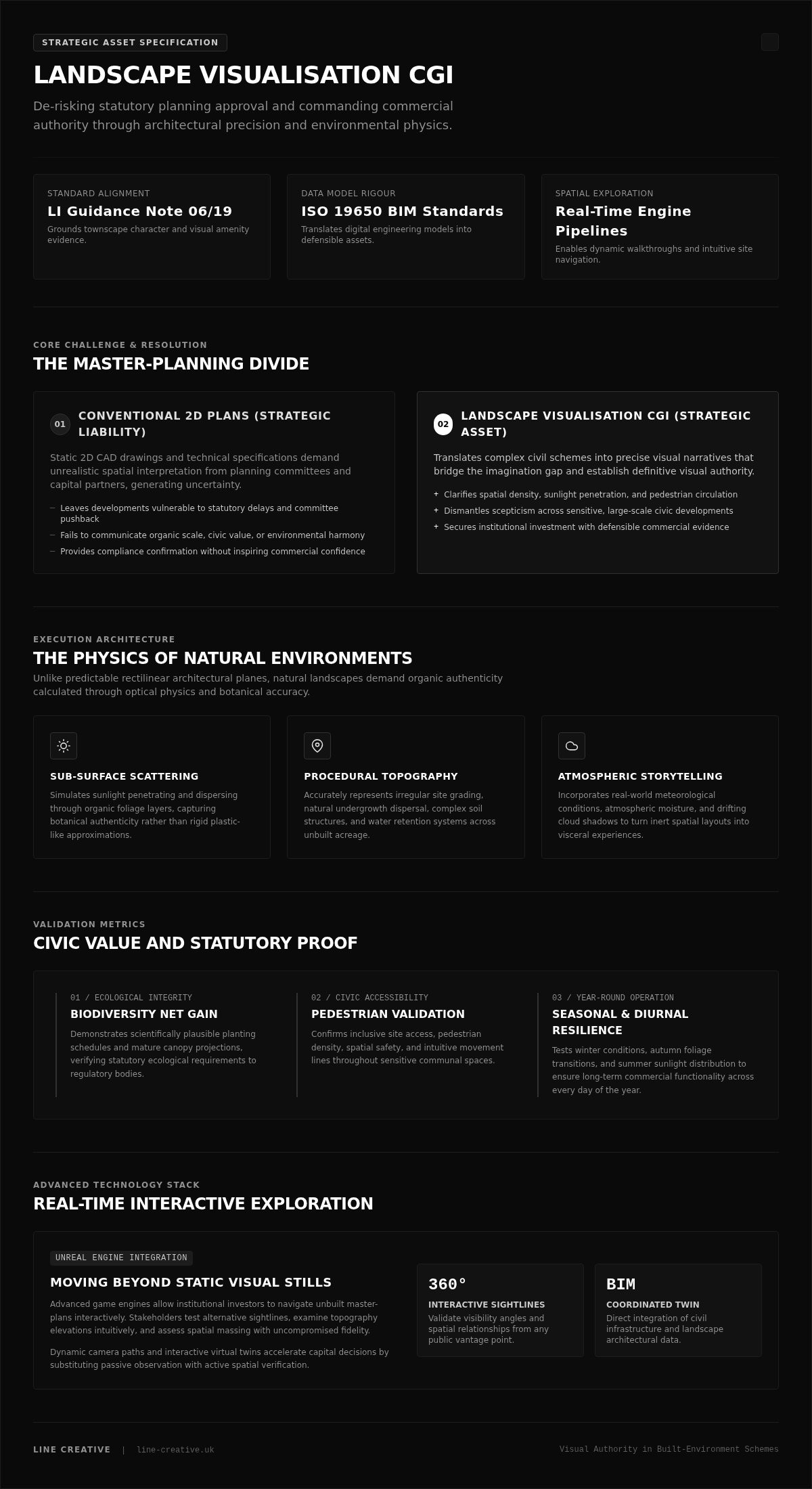
Traditional representations often fail under intense commercial scrutiny. Static two-dimensional plans demand an unrealistic degree of spatial interpretation from planning officers and non-technical stakeholders, frequently creating uncertainty. High-calibre 3D narratives resolve this friction, clarifying spatial density, sunlight penetration, and pedestrian circulation across entire master-plans. While standard technical renders serve primarily to confirm compliance, premium marketing assets actively build visual authority, helping schemes attract global capital by presenting a cohesive vision of long-term community value.
The Role of LI Guidance in Modern Visualisation
Rigorous visual planning relies on established industry frameworks. Adhering to the principles outlined in Landscape Institute (LI) Guidance Note 06/19 ensures that representations of townscape character and visual amenity remain methodologically grounded. High-value proposals require an unshakeable evidence base to withstand critical public inquiries and committee challenges. Premium landscape visualisation CGI balances this uncompromised technical accuracy with cinematic visual storytelling, producing evocative images that meet statutory expectations whilst retaining strong commercial appeal.
Beyond the Building: The Importance of Place-making
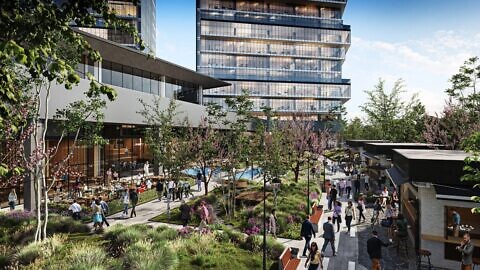
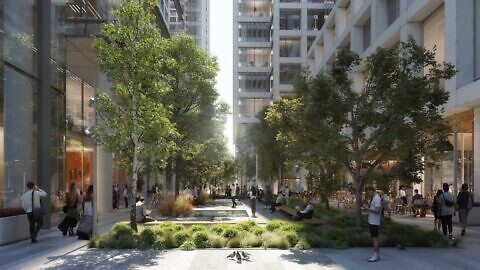
Value resides in outdoor communal environments. The open spaces between buildings dictate whether an urban district succeeds or falters commercially. Thoughtfully crafted CGI proves social value, demonstrating active civic spaces, sustainable drainage systems, and mature canopy growth long before ground is broken.
- Demonstrates biodiversity net gain through scientifically plausible planting schedules.
- Validates pedestrian movement, inclusive access, and spatial safety across diverse seasons.
- Establishes an emotional bridge between civic responsibility and commercial viability.
To see how technical mastery elevates sensitive urban and rural environments, explore our portfolio of complex landscape schemes.
The Technical Artistry of Photorealistic Outdoor Environments
Outdoor environments present an intense technical challenge that architectural geometry rarely demands. While built structures rely on predictable rectilinear planes and uniform materials, natural landscapes require absolute organic chaos. Replicating believable topographies involves calculating how sunlight scatters through sub-surface leaf layers, scattering random undergrowth naturally, and capturing atmospheric moisture realistically. Photorealistic landscape rendering is the precise marriage of optical physics and botanical accuracy, ensuring that foliage, soil, and water systems behave exactly as they do in the physical world.
Static framing alone cannot capture the complete experience of a dynamic master-plan. Compelling landscape visualisation CGI relies on atmospheric storytelling to immerse the viewer. Shifting meteorological conditions, drifting cloud shadows, and seasonal plant transitions transform inert site plans into emotionally resonant spatial journeys, turning passive viewers into committed stakeholders.
Disruptive Technology: Unreal Engine and Immersive Films
Static imagery is rapidly being supplemented by real-time exploration. Advanced game engines like Unreal Engine enable institutional investors to walk through unbuilt acreage, test alternative viewpoints interactively, and understand topographic elevations intuitively. Moving camera paths evoke visceral emotional engagement that two-dimensional stills cannot replicate. If you want to deploy these real-time tools to accelerate investor buy-in across your master-plan, discover our virtual production and VR capabilities.
Seasonal and Diurnal Variations
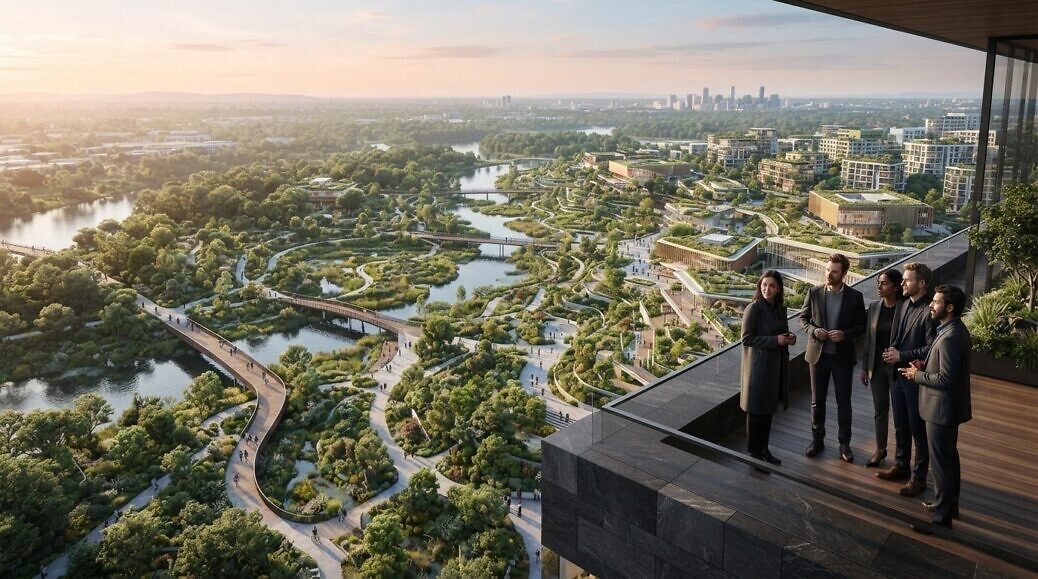
A development must prove its commercial viability every day of the year. Demonstrating winter resilience, autumn foliage transitions, and summer vibrancy reassures planning committees that a public realm remains sustainable across varying weather patterns. For prime residential and luxury resort schemes, the warm, low-angled light of the golden hour brings distinct advantages:
- Accentuates stone masonry, open water features, and delicate planting textures.
- Evokes an exclusive, tranquil sanctuary that appeals directly to prospective buyers.
- Softens building masses, seamlessly embedding built architecture into the surrounding countryside.
To explore how cinematic lighting elevates broader property presentations, consider our 3D rendering methodologies.
Strategic Outcomes: Securing Planning and Global Investment
For developers undertaking high-value mixed-use developments, landscape visualisation CGI acts as a vital risk-mitigation tool. Planning committees rarely reject projects purely on technical engineering grounds. Instead, refusals frequently stem from an imagination gap: the inability of local councillors and community stakeholders to visualise how an ambitious scheme will coexist with established natural or urban surroundings. By translating complex massing plans into unassailable visual representations, precision CGI strips ambiguity away from committee rooms, transforming potential public opposition into vocal advocacy.
Winning Planning Permission for Sensitive Sites
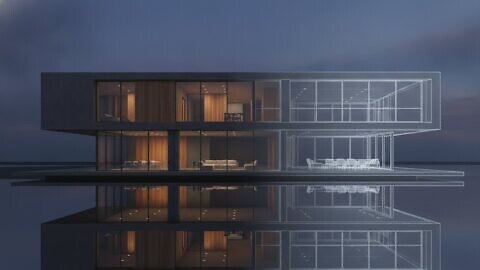
Sensitive landscape designations, green belts, and historic conservation zones carry high levels of regulatory scrutiny. Navigating these environments demands radical transparency. By pairing structured wireframes and massing envelopes with photorealistic contextual landscaping, developers can systematically demonstrate scale, roofline modulation, and sightline preservation. Presenting daylight distribution and verified tree-canopy growth gives planning bodies clear evidence that development safeguards open civic spaces, radically accelerating statutory sign-off. To see how we communicate dense civic environments, examine our architectural rendering solutions.
Maximising ROI through Pre-Build Marketing
Securing planning approval is only the initial hurdle. High-value projects require sustained commercial momentum to attract sovereign wealth funds, institutional lenders, and luxury hospitality operators. Premium landscape visualisation CGI builds the experiential narrative before ground-break, proving commercial vitality through animated pedestrian zones, al fresco hospitality spaces, and tranquil private parklands.
High-calibre outdoor imagery delivers immediate commercial dividends:
- Accelerates off-plan residential pre-sales by evoking an aspirational standard of living.
- Persuades international hotel brands and commercial tenants through accurate spatial place-making.
- Protects scheme valuation by demonstrating uncompromising design standards to global capital.
When billions in gross development value hinge on stakeholder confidence, visual mediocrity is an unacceptable liability. Contact us to discuss your next high-stakes project and secure the visual authority your scheme requires.
Partnering with Line Creative: Award-Winning Landscape CGI
World-leading architectural practices and hospitality leaders, including Zaha Hadid Architects and Aman Resorts, trust Line Creative to articulate their most complex built-environment schemes. These partnerships succeed because we operate not merely as external production technicians, but as dedicated strategic allies who understand the gravity of multi-million-pound planning bids. By fusing rigorous architectural precision with cinematic realism, our landscape visualisation CGI shields schemes against misinterpretation, establishing authoritative visual evidence before planning authorities and investment syndicates across the UK, Europe, and the Middle East.
Our pedigree is grounded in tangible industry recognition. Backed by multiple CGarchitect Awards and SME UK honours, our studio brings proven visual authority to every project. This level of technical excellence ensures that every contour, mature tree root, and water reflection aligns precisely with your project’s overarching commercial and civic objectives.
A Collaborative, Strategic Partnership
High-stakes developments require active collaboration rather than transactional image delivery. We work directly alongside design teams, master-planners, and landscape architects to interrogate early massing models, refine focal sightlines, and establish a cohesive design narrative. This collaborative workflow identifies potential visual liabilities early, allowing adjustments before submissions reach formal scrutiny. To understand how this strategic alignment benefits expansive schemes, read our dedicated architectural visualisation analysis.
The Unreal Studio Experience
Translating static acreage into visceral motion demands advanced production pipelines. Through our bespoke Unreal Studio Experience films, we deploy real-time game engines to produce cinematic walkthroughs tailored for executive presentations and investor marketing suites. Moving cameras capture natural wind displacement across foliage, changing solar trajectories, and shifting light conditions in photorealistic detail.
- Transforms abstract landscape frameworks into persuasive commercial films.
- Enables decision-makers to experience spatial flow and materials interactively.
- Delivers unforgettable assets that accelerate institutional funding rounds.
To view our continuous design experiments and cinematic imagery, follow our latest work on Instagram.
Transform Your Master-Plan into Defensible Visual Authority
Navigating the journey from conceptual master-planning to ground-break requires more than technical compliance. To secure planning consent and mobilise institutional capital, complex schemes demand clarity, atmospheric resonance, and absolute architectural precision. Strategic landscape visualisation CGI bridges the gap between technical design and political approval, converting public and regulatory hesitation into definitive advocacy across sensitive development sites.
World-leading architectural innovators like Zaha Hadid Architects and luxury operators such as Aman Resorts trust Line Creative to communicate their grandest visions. Recognised with multiple CGarchitect Awards and SME UK honours, our studio specialises in high-value, complex master-planning developments across the globe. We safeguard your investment by ensuring every environmental nuance and public space speaks directly to decision-makers. Don’t leave your project’s statutory consent to chance. Partner with Line Creative to transform your landscape vision into a compelling visual story.
Frequently Asked Questions
How does landscape visualisation CGI assist with planning permission?
Landscape visualisation CGI provides planning committees with clear visual evidence of how a scheme integrates with its natural context. Instead of forcing councillors to decode complex 2D grading plans and technical elevations, photorealistic CGI demonstrates accurate building massing, daylight distribution, and amenity preservation. This clarity dismantles subjective ambiguity, directly resolves statutory objections, and de-risks the approvals process for sensitive master-plans.
What is the difference between architectural rendering and landscape CGI?
Architectural rendering focuses primarily on the built structure, detailing facade materials, internal spaces, and geometric volumes. In contrast, landscape visualisation CGI prioritises the organic context and public realm surrounding the architecture. It requires specialised computational methods to simulate botanical growth, topography, water systems, and shifting natural light. This ensures the environment feels established, authentic, and naturally connected to the building.
Can landscape CGI show seasonal changes for a development?
Yes. Advanced digital pipelines simulate botanical lifecycles across spring blooms, lush summer foliage, autumn colouration, and winter dormancy. Depicting a master-plan across all four seasons proves the public realm remains welcoming and commercially viable year-round. It reassures planning officers and institutional investors that the development will thrive throughout changing weather conditions and annual cycles, rather than solely on ideal summer afternoons.
How much does high-end landscape visualisation cost?
Investment levels for high-end landscape visualisation depend on project scope, spatial scale, and intended deliverables. Key variables include overall master-plan acreage, botanical complexity, 3D model density, and whether deliverables require high-resolution stills or real-time digital animations. Rather than offering fixed tariffs, specialist studios tailor every commission to the strategic commercial stakes, ensuring the visual assets deliver measurable returns during planning and investor pitches.
Why should developers invest in CGI animation for landscapes?
Static images cannot convey spatial flow or human scale across extensive master-plans. Investing in CGI animation brings open acreage to life through natural motion, changing daylight, and realistic camera journeys. It transforms passive site plans into compelling narratives that captivate sovereign wealth funds and institutional lenders. For marketing suites, animated walkthroughs create emotional buy-in long before physical construction commences, accelerating commercial pre-sales.
What software is used for professional landscape visualisation in 2026?
Leading visualisation studios rely on real-time platforms like Unreal Engine 5.8 alongside traditional offline rendering engines such as V-Ray and Corona. Advanced workflows incorporate Procedural Content Generation tools to populate complex plant ecosystems naturally, alongside AI-assisted denoising to accelerate production. These platforms integrate directly with ISO 19650-compliant BIM models, ensuring absolute architectural accuracy whilst generating cinematic visualisations for planning applications and investor campaigns.