Treating 3d product animation cost as an arbitrary tally of billable studio hours is the quickest route to compromised visual quality and diluted brand prestige. You already recognise the immense frustration of opaque studio estimates, volatile delivery schedules, and sudden scope revisions that disrupt critical launch windows. In high-stakes investor pitches and competitive retail rollouts, settling for flat, sub-standard computer imagery isn’t merely an aesthetic compromise. It’s an active commercial liability that confuses discerning buyers, diminishes perceived value, and compromises your technical innovation.
Discover the exact technical and creative variables governing production investment so you can eliminate operational ambiguity, mitigate execution risk, and maximise your commercial return. We provide an authoritative evaluation framework covering CAD data optimisation, studio pipeline discipline, and render fidelity. You’ll gain the precise technical vocabulary and strategic clarity required to evaluate proposals confidently, ensuring your visual assets command long-term visual authority across every digital channel.
Key Takeaways
- Evaluate how geometric complexity, physical simulations, and artistic staging dictate 3d product animation cost far more than simple runtime metrics.
- Specify critical technical specifications with precision, ensuring physically based materials and bespoke lighting achieve photorealistic product rendering on schedule.
- Mitigate commercial risk by identifying why dedicated studio infrastructure outperforms fragmented freelance marketplaces in computing power and pipeline discipline.
- Implement modular project planning to extract multiple high-impact marketing deliverables from a single master production, securing sustained visual authority.
Primary Drivers Governing 3D Product Animation Investment
Every commercial production hinges on technical scope rather than arbitrary studio clock-watching. Production expenditure depends directly upon geometry complexity, shot duration, and artistic staging. While commodity platforms quote flat rates for basic rotational loops, bespoke industrial visualisations demand deep engineering scrutiny to communicate mechanical value. Understanding these core dependencies clarifies how your overall 3d product animation cost takes shape.
Commissioning bespoke assets is an investment in reusable intellectual property across modern digital marketing strategy. Rigorous storyboarding and creative direction establish narrative pacing designed to capture investor focus and drive direct commercial conversion, rather than simply generating moving pixels.
Geometry Complexity and CAD Optimisation
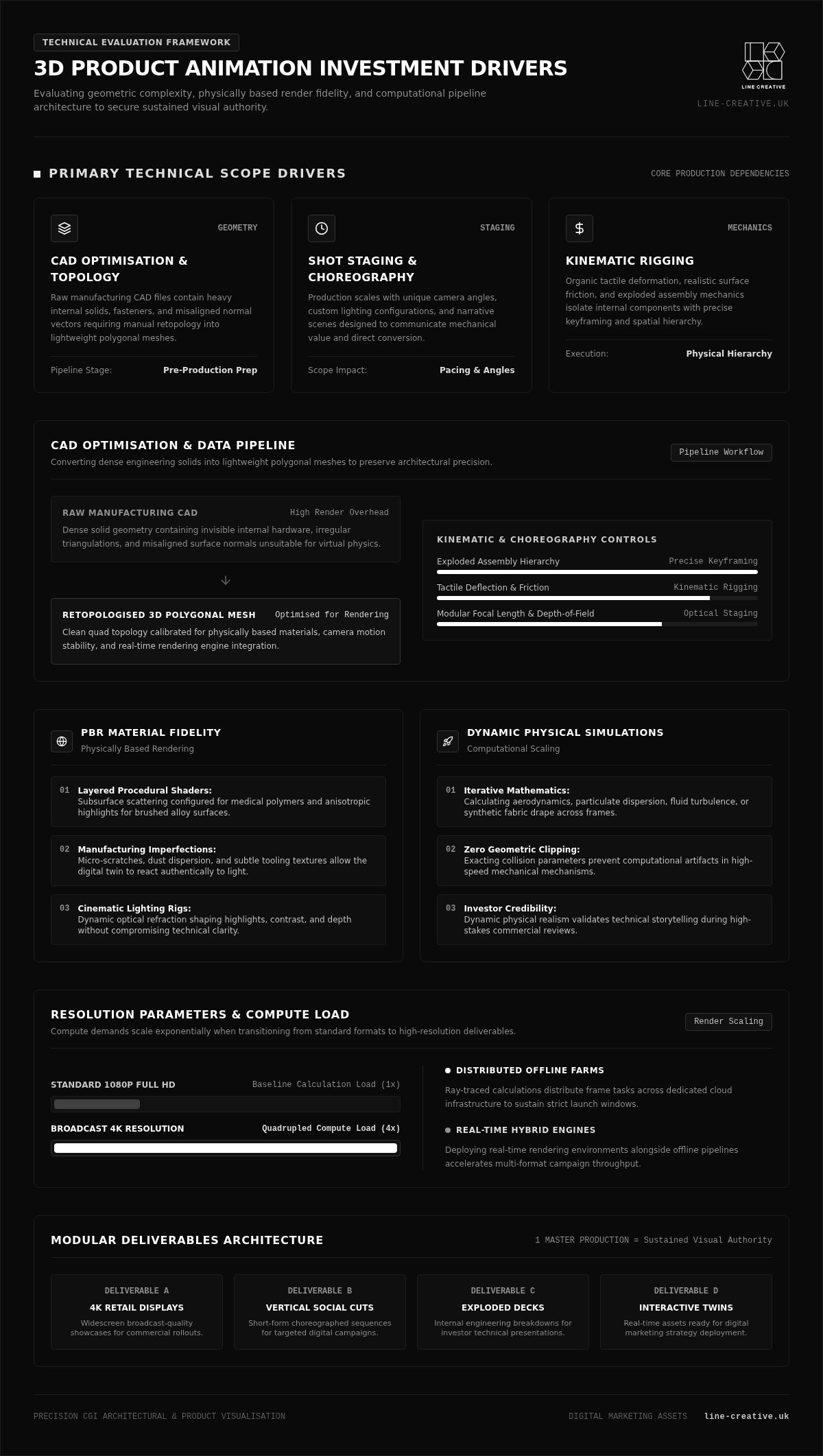
CAD optimisation serves as the foundational determinant of animation fidelity, dictating how cleanly digital geometry responds to virtual physics. Raw manufacturing CAD files routinely contain interior geometry, hidden fasteners, and misaligned normal vectors requiring extensive manual clean-up before creative staging can begin. Through meticulous retopology, technical artists convert dense engineering solids into lightweight polygonal meshes within modern 3D computer graphics pipelines. This labour preserves architectural precision across every frame while ensuring real-time stability for your 3D rendering assets.
Runtime Duration, Pacing, and Shot Composition
Runtime alone rarely tells the full story of production scope. Production investment scales with the number of unique camera angles, lighting states, and narrative scenes required to present product functionality convincingly.
- Exploded assembly sequences: Isolating internal engineering components demands strict spatial hierarchy, precise keyframing, and mechanical coordination.
- Organic interaction and micro-movements: Introducing realistic deflection, surface friction, or tactile deformation requires specialised kinematic rigging that simple linear movements avoid.
- Modular camera choreography: Creating variable focal lengths and depth-of-field sweeps requires bespoke artistic staging per sequence to sustain viewer interest.
These combined disciplines safeguard against visual inconsistency, directly aligning the 3d product animation cost with lasting commercial prestige.
Technical Specifications Influencing Studio Production Scope
Technical specifications form the operational baseline of any production quote. Superficial visualisations rely on default digital shaders, but true photorealistic product rendering requires bespoke material recreation, dynamic optical refraction, and rigorous physical calculation. How a studio calibrates these variables directly governs your overall 3d product animation cost and guarantees your final render preserves brand equity under close consumer scrutiny.
Material Fidelity, PBR Shading, and Photorealism
Convincing product visualisation demands Physically Based Rendering (PBR) workflows. Studio artists build layered procedural shaders, configuring subsurface scattering for medical polymers and anisotropic highlights for brushed alloys. They introduce micro-scratches, dust dispersion, and subtle manufacturing imperfections so the digital twin reacts authentically to virtual light. Lighting rigs mirror physical cinematography, shaping highlights, contrast, and depth to evoke emotional connection without sacrificing visual clarity.
Simulation Complexity and Dynamic Visual Effects
Static parts rarely test technical capabilities, but physical simulations rapidly scale render load. Calculating aerodynamics, particulate dispersion, fluid turbulence, or synthetic fabric drape requires iterative mathematical computation cycles. Exacting collision parameters ensure high-speed mechanisms behave without geometric clipping or computational artifacts. These dynamic effects elevate technical storytelling, providing investor presentations with unmatched visual credibility.
Rendering Pipeline and Resolution Deliverables
Resolution parameters dictate compute infrastructure demands. Moving from standard 1080p to broadcast 4K quadruples render frame calculation loads across dedicated offline farms. To balance throughput, modern pipelines deploy real-time rendering environments alongside ray-traced engines. Cloud infrastructure is essential here; as industry keynotes demonstrate when addressing methods for , cloud compute distributes frame tasks efficiently across multi-format marketing campaigns.
Specifying vertical social cuts, widescreen retail displays, and interactive configurations from the outset safeguards delivery timelines. If you’re calibrating exact technical specifications for an upcoming campaign, reviewing the cinematic benchmark within Line Creative’s project portfolio demonstrates how disciplined studio pipelines prevent costly scope revisions.
Production Models Compared: Dedicated Studios vs Freelance Marketplaces
Procurement teams frequently weigh the apparent economy of gig aggregators against the structured reliability of established visual partners. While transactional platforms market accessible entry pricing, they obscure significant operational overheads. Fragmented communications, compounding revision rounds, and missed retail launch windows quickly erode initial savings. A specialist agency operates not as a temporary gig hire, but as a strategic partnership committed to safeguarding your market launch.
Hardware capability marks another decisive operational divide. Independent contractors rarely possess the local computing infrastructure or enterprise cloud render farm access required for complex, high-resolution frame sequences. When pipeline bottlenecks occur, individual freelancers stall. Dedicated visualisation studios eliminate these bottlenecks entirely, deploying scalable computing clusters that keep high-stakes projects aligned with rigid marketing milestones.
The Hidden Liabilities of Dispersed Freelance Platforms
Sourcing disparate contractors introduces severe visual and operational vulnerabilities. Independent animators work with inconsistent colour spaces, unstandardised shader libraries, and incompatible scene setups. When assembling broader campaigns, the resulting visual assets lack cohesive visual authority. Strict intellectual property protection and enterprise non-disclosure enforcement also become precarious across borderless freelance clearinghouses. Unplanned technical fixes, scope adjustments, and asset rebuilds steadily drive up the real 3d product animation cost, erasing whatever financial margin justified the hire.
The Value Proposition of a Dedicated Visualisation Studio
Dedicated studios unite creative directors, technical artists, and visual effects specialists within a synchronised production pipeline. Rather than passing files between disconnected contractors, your assets move through calibrated quality checkpoints that guarantee lighting consistency, accurate kinematics, and material fidelity. Studios with award-winning CGI credentials bring cross-industry discipline to technical storytelling, turning product geometry into a lasting strategic asset.
Before committing capital to an unproven contractor, examine established commercial workflows. Explore the studio portfolio of Line Creative to evaluate the tangible impact of premium visual standards across international campaigns.
If you’re preparing a critical product debut and require absolute technical precision, contact Line Creative to establish a resilient production framework tailored to your commercial goals.
Maximising Commercial Return: Structuring Your Animation Project
Maximising investment value requires deliberate commercial planning from day one. When marketing directors evaluate 3d product animation cost, they often treat production as a single-use expense rather than an enduring asset purchase. In the debate of CGI vs. Traditional Photography, digital production delivers complete staging freedom without physical venue rentals, shipping delays, or weather dependencies. While digital renders excel for controlled product demonstrations, live consumer reveals and industry trade showcases still call for dedicated on-site visual coverage; working with established specialists like The Photography Co allows marketing teams to capture in-person launch momentum alongside their virtual assets. A calibrated digital twin remains accessible indefinitely, ready to adapt whenever packaging updates or technical iterations emerge.
Disciplined early scoping prevents scope creep whilst synchronising production milestones with launch deadlines. Structuring the creative brief around modular visual deployment ensures your initial expenditure yields sustained visibility across every marketing touchpoint.
Drafting an Exacting Production Specification
Precise technical inputs determine project velocity. Before opening production scenes, define target display parameters, core conversion goals, and critical aspect ratios for omni-channel distribution. Gather manufacturing CAD files, Pantone specifications, and physical material references in advance to accelerate studio preparation. You can review established protocols in our 3D rendering studio standards to align your technical criteria with professional production pipelines.
Asset Multi-Purposing Across Your Digital Marketing Strategy
Extracting multiple deliverables from a single unified production master transforms your commercial balance sheet. A single animated sequence provides the foundation for an entire visual campaign:
- Print-ready marketing stills: Capture ultra-high-resolution static imagery directly from completed camera angles without scheduling supplementary photo shoots.
- Modular motion cut-downs: Segment primary product narratives into 6-second vertical clips, looping exhibition displays, and interactive website hero banners.
- Interactive stakeholder tools: Migrate textured product geometry directly into immersive interactive experiences to engage prospective investors.
To understand how this integrated methodology strengthens consumer trust, read how product visualisation elevates brand authority across fast-moving modern sectors.
Securing a Strategic Partnership for Global Distribution
Protecting commercial momentum requires working with a creative partner that understands commercial stakes. Direct communication with senior visual artists eliminates translation errors, protecting critical retail launch dates. You can initiate project scoping with an established creative ally via the Line Creative contact team to secure exceptional production standards for your next campaign.
Transforming Visual Production into Commercial Value
Treating visual production as a tactical procurement task risks your market positioning. Production scale, geometric preparation, and physically based rendering requirements dictate 3d product animation cost. By specifying clear technical parameters and adopting modular content delivery, you turn digital animation into an enduring strategic asset that outperforms conventional media across global channels.
Securing this level of visual authority requires an experienced creative ally. Winner of multiple CGarchitect Awards and SME UK Award recognition, Line Creative is a trusted partner to world-leading brands including Epic Games and luxury design firms. Our unified studio pipeline guarantees technical precision, eliminating delivery risks whilst elevating brand prestige across every customer touchpoint.
Position your next product launch for measurable commercial success. Discuss your visual communication strategy with Line Creative today and build digital assets that captivate global audiences.
Frequently Asked Questions
How is 3D product animation cost calculated across professional creative studios?
Professional studios evaluate production investment based on geometric complexity, narrative scope, and visual simulation requirements. Rather than applying simple hourly rates, your 3d product animation cost reflects technical preparatory tasks like retopology, bespoke shader configuration, camera choreography, and compute allocation across dedicated render farms. This structured scoping ensures projects achieve photorealistic fidelity without sudden revisions or delivery delays.
Why do CAD file conditions affect overall product animation project pricing?
Raw engineering CAD models frequently contain messy topology, internal mechanical fasteners, and non-manifold geometry unsuitable for dynamic animation. Visual artists must manually clean, organise, and retopolise the digital model into an animation-ready mesh. High-quality initial CAD data reduces this labour-intensive pre-production phase significantly, allowing studio resources to focus immediately on creative lighting, cinematic cinematography, and material calibration.
Can 3D product animation assets be repurposed for print and digital marketing?
Yes, digital assets generated for animation form an adaptable library for cross-channel marketing campaigns. High-resolution stills can be captured directly from production scene files for high-impact print collateral, packaging, and digital advertisements without reshooting. Equally, the geometry transitions seamlessly into interactive web viewers, AR environments, and looping social cuts, multiplying overall commercial return from a single production pipeline.
How does CGI compare financially with traditional live-action product videography?
While physical cinematography incurs ongoing expenses for studio hire, location logistics, physical prototyping, and weather delays, CGI operates within a fully controllable virtual space. A calibrated 3D asset provides indefinite digital longevity; packaging changes, colour variations, and functional upgrades can be rendered without scheduling subsequent shoots. This adaptability turns the initial investment into a scalable strategic asset for global distribution.
What technical assets must our company provide to commission a 3D product animation?
Effective studio onboarding begins with accurate manufacturing CAD files, typically in STEP, IGES, or SolidWorks formats. In addition, providing brand style guidelines, Pantone colour references, and real-world material swatches ensures precise shader matching. A preliminary storyboard or bulleted functional breakdown also accelerates narrative alignment, ensuring our artists accurately highlight your engineering distinctions from the very first animatic pass.
Does rendering resolution significantly impact the production timeframe and studio investment?
Output resolution directly dictates the processing cycles required from offline render farms. Moving from standard 1080p high definition to cinema-grade 4K delivery quadruples the computing load per frame, influencing delivery schedules and operational 3d product animation cost. Production studios often balance these computing requirements by pairing real-time engines for rapid pre-visualisation with high-precision offline ray tracing for final delivery masters.