A multi-million-pound investment rarely fails because of the numbers; it fails because the board cannot see the future you’re describing. In an environment of information overload, a spreadsheet alone isn’t enough to bridge the gap between architectural intent and financial projections. High-stakes development requires a definitive solution to visual ambiguity. Deploying bespoke 3D renders for investors isn’t merely about aesthetic polish; it’s a strategic necessity to ensure every stakeholder is aligned before the first stone is turned.
You’ve likely seen high-value raises stall whilst partners grapple with the perceived risks of an unrendered vision. It’s a frustrating barrier that delays progress and erodes confidence. This article demonstrates how to leverage high-end CGI to de-risk your schemes and secure faster capital commitments. We’ll examine the methodology behind using disruptive technology to streamline due diligence and increase the perceived value of your assets long before construction begins.
Key Takeaways
- Learn why spreadsheets fail to communicate true asset value and how 3D renders for investors provide the visual proof required to bridge the gap between financial projections and physical reality.
- Discover the “Hero Image” strategy to create an undeniable vision of your development that aligns diverse stakeholders and simplifies complex mixed-use narratives.
- Understand how to deploy sophisticated CGI across the entire investment lifecycle to de-risk planning applications and secure essential early-stage seed capital.
- Identify the critical distinctions between a standard CGI vendor and a strategic visual communication partner capable of navigating high-stakes international markets.
Beyond Aesthetics: The Strategic Role of 3D Renders in Capital Raising
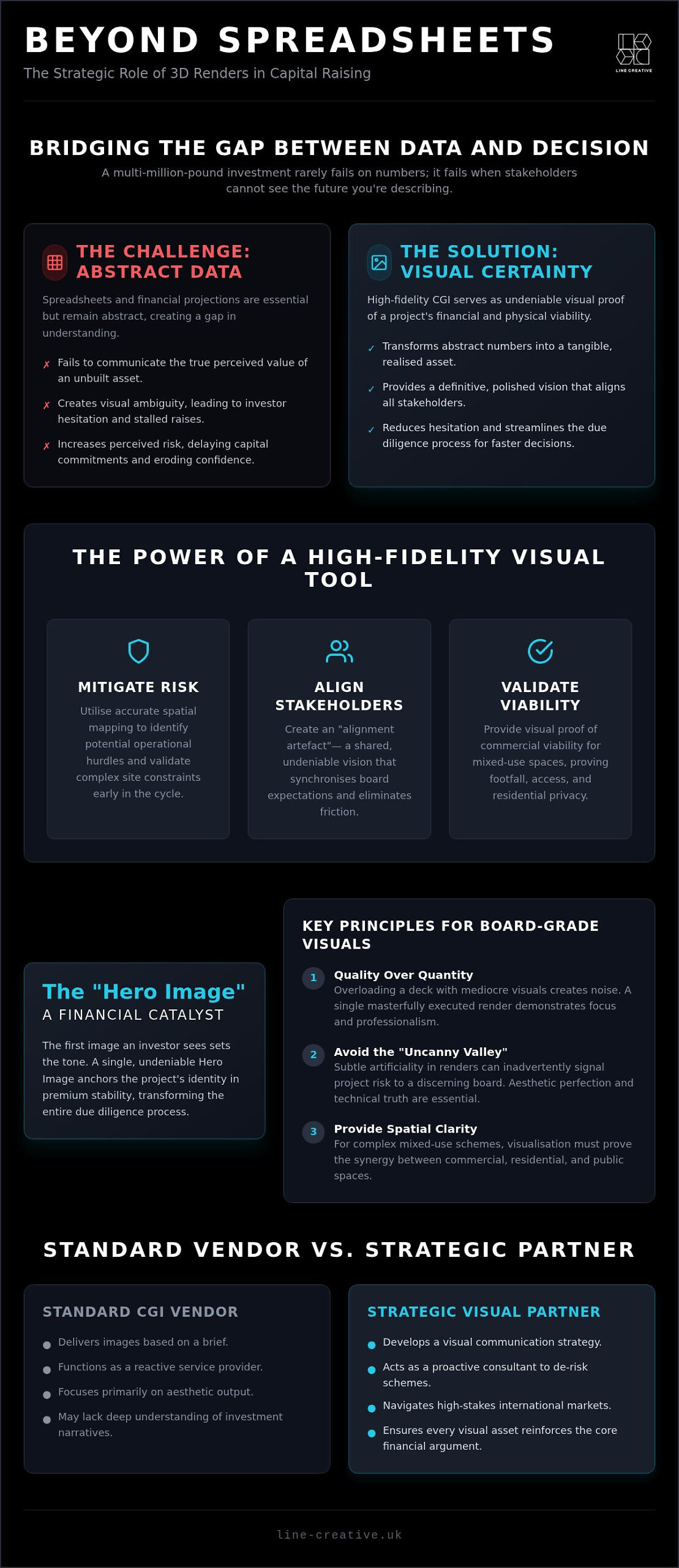
High-value development is rarely a matter of simple construction; it is a complex exercise in confidence. For the developer, bespoke 3D renders for investors serve as undeniable visual proof of a project’s financial and physical viability. Whilst a traditional pro forma provides the mathematical foundation, it remains an abstract concept that fails to communicate the perceived value of an unbuilt asset. Numbers on a page cannot evoke the sense of place, the quality of light, or the commercial gravity that high-end imagery commands.
The transition from a design concept to a funded reality requires a fundamental psychological shift. Stakeholders must move from merely viewing a proposed design to evaluating a tangible investment opportunity. This shift is facilitated by photorealistic precision. When an investor sees a scheme rendered with technical accuracy, the perceived risk diminishes. They aren’t looking at an artist’s impression; they’re looking at a realised future. This clarity is the essential safeguard against the hesitation that often stalls multi-million-pound raises.
Visualising the Capital Stack
CGI functions as the vital bridge between architectural intent and financial forecasting. It allows Limited Partners (LPs) and institutional boards to grasp the desirability of a scheme long before the first spade enters the ground. By presenting a definitive, polished vision, developers can prove the commercial viability of mixed-use spaces or luxury residential units amongst even the most sceptical audiences. We define the alignment artifact as a high-fidelity visual tool used to synchronise board expectations and eliminate the friction often found between design intent and fiscal reality. It ensures that every member of the capital stack is moving toward the same objective with absolute clarity.
This visual narrative is particularly effective when targeting high-net-worth investors who value both architectural excellence and lifestyle potential. For example, GuestLee demonstrates how the scenic beauty of prime Swiss locations can be leveraged to enhance the perceived value and long-term appeal of luxury residential assets.
Risk Mitigation Through Precision
Ambiguity is the enemy of capital commitment. The strategic deployment of 3D renders for investors removes this obstacle by utilising accurate spatial mapping to identify potential operational hurdles early in the cycle. The evolution of computer graphics rendering has transformed these visuals from simple sketches into high-fidelity assets that validate every architectural decision. Engaging specialist CGI services provides the technical rigour required to validate complex site constraints—often incorporating precise as-built data from Site Wiz Surveys—ensuring that the final output is both aesthetically perfect and functionally sound. This level of precision reduces investor hesitation, streamlines the due diligence process, and reinforces the developer’s position as a prepared, professional, and authoritative partner.
How to Optimise Your Investor Deck with High-Impact CGI
Boardroom presentations demand precision over mere decoration. When structuring a raise, the requirement for 3D renders for investors shifts from aesthetic appeal to rigorous technical validation. A board-grade visualisation does more than look attractive; it must withstand intense scrutiny regarding scale, material authenticity, and environmental context. This is the definitive solution to the information overload found in traditional investor decks. By placing high-fidelity imagery alongside your key ROI metrics, you transform abstract financial data into a tangible, realised asset.
The Hero Image as a Financial Catalyst
The first image an investor sees sets the tone for the entire due diligence process. A single, undeniable Hero Image acts as a financial catalyst, anchoring the project’s identity in a sense of premium stability. We prioritise quality over quantity. Overloading a deck with mediocre visuals creates noise and suggests a lack of focus. Conversely, a masterfully executed render avoids the uncanny valley. This term describes the unsettling feeling of artificiality that can inadvertently signal project risk to a discerning board. Professional credibility in high-stakes meetings is maintained through aesthetic perfection and technical truth.
Spatial Clarity for Mixed-Use Complexity
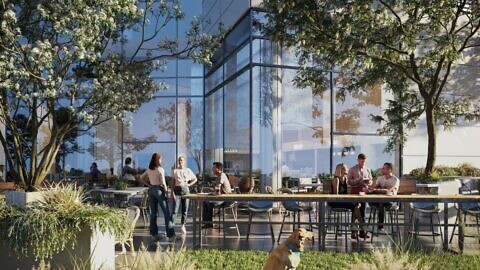
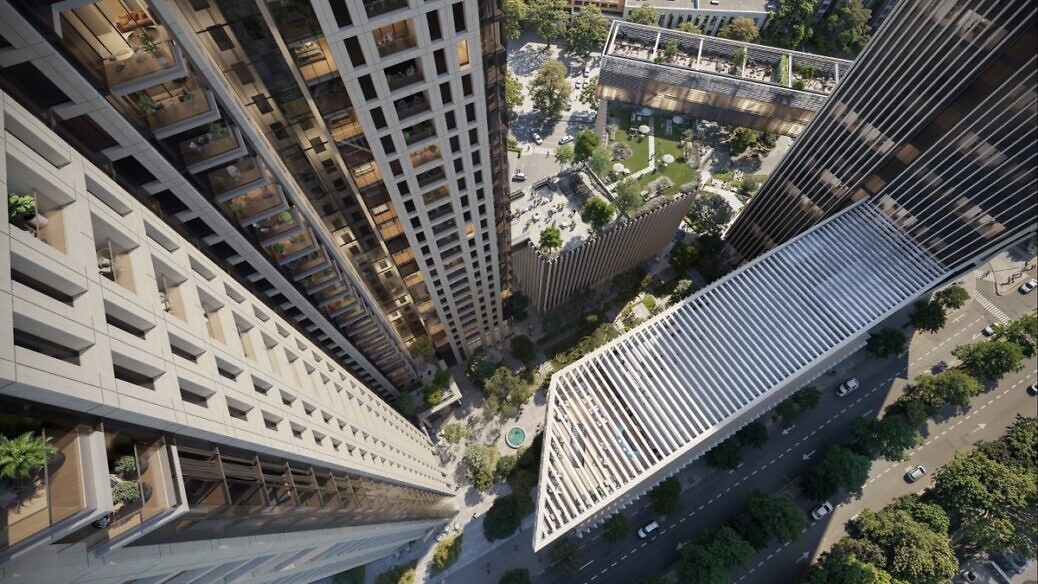
Complex schemes require a nuanced narrative that balances commercial, residential, and public realm interests. Sophisticated architectural visualisation is the primary tool for demonstrating the synergy between these diverse asset classes. It allows you to prove the flow and accessibility of a site whilst maintaining a sharp focus on the primary investment targets. Investors need to see how the public realm supports commercial footfall and how residential privacy is preserved amongst high-traffic zones. For developers navigating the particular challenges of urban master-plans, mixed-use development CGI provides the definitive methodology for transforming these multifaceted concepts into clear, persuasive visual narratives that accelerate both planning approval and commercial pre-lets. This spatial clarity removes ambiguity and accelerates the decision-making cycle.
Integrating these visuals with your financial projections creates a powerful argument for project viability. According to industry data from August 2026, properties featuring advanced 3D visualisations and interactive tours can sell up to 31% faster than those relying on static plans alone. This accelerated absorption rate is a critical metric for investors evaluating exit strategies. To see how these principles are applied to global mixed-use schemes, consider reviewing our portfolio of strategic visualisations. By aligning your visual narrative with documented buyer behaviour, noting that 63% of purchasers now make offers based on virtual tours, you provide the board with the confidence they need to commit capital to your vision.
Implementing 3D Visualisation Across the Investment Lifecycle
Strategic visual communication is a continuous requirement that spans the entire development timeline. The deployment of 3D renders for investors is not a static event; it is a dynamic programme that evolves as a project matures from a conceptual sketch to a realised asset. Each phase of the investment lifecycle demands a specific visual language to address the shifting concerns of stakeholders, from early-stage seed investors to long-term institutional partners.
- Phase 1: The Initial Raise. Conceptual renders establish immediate buy-in, providing the visual clarity needed to secure seed capital before detailed architectural work begins.
- Phase 2: Planning and Entitlements. Integrating CGI for planning permission de-risks the approval process by demonstrating site sensitivity and design excellence to local authorities.
- Phase 3: The Offering Memorandum. This is the definitive visual narrative. Here, high-end 3D Rendering creates the emotional and logical justification for the full capital raise.
- Phase 4: LP Updates and Refinancing. Progress animations and flythroughs keep Limited Partners engaged, providing tangible evidence of construction milestones and maintaining momentum during long development cycles.
Securing Planning to Protect the Raise
Planning risk remains the primary concern for most institutional investors. Failure to secure entitlements can render a multi-million-pound investment worthless overnight. Leveraging the expertise of a specialist CGI studio allows developers to navigate complex urban planning requirements with absolute precision. Within this high-stakes environment, a single verified view can be the definitive difference between project approval and a costly rejection. These assets provide a scientifically accurate representation of a building’s impact on its surroundings, removing the subjective ambiguity that often leads to planning delays. By presenting 3D renders for investors that are grounded in technical truth, you prove that the scheme is not just desirable, but deliverable.
Refining the Narrative for LP Updates
Maintaining investor excitement over a multi-year construction timeline requires more than just static reports. Consistent visual branding throughout the lifecycle ensures that the project remains a priority for the board. Using 3D animation for commercial real estate allows developers to manage the transition from “vision” to “reality” by updating digital assets as the build progresses, communicating scale, rhythm, and commercial potential in ways that static imagery alone cannot achieve. This ongoing engagement protects the initial investment and simplifies the process of future refinancing or secondary market sales. If you are ready to de-risk your next high-value scheme through superior visual communication, contact our team to discuss a bespoke strategy tailored to your capital requirements.
Choosing a Specialist Partner for High-Stakes Developments
The distinction between a mere CGI vendor and a strategic visual communication partner is defined by the outcome. A vendor delivers a set of files; a partner delivers a mechanism for securing capital. For developers managing complex mixed-use schemes, the requirement is for a team that understands the gravity of the financial stakes involved. This necessitates a studio with the international experience to handle diverse investor expectations across global markets, ensuring that every asset produced is aligned with the specific cultural and fiscal requirements of the board.
Disruptive Technologies in the Boardroom
The modern digital landscape has shifted the expectations of institutional investors. Static imagery is no longer the ceiling; it is the floor. We are seeing a significant move towards virtual production and augmented reality for investor walkthroughs. By leveraging real-time rendering engines like Unreal Engine, developers can facilitate “live” design adjustments during stakeholder meetings. This interactive capability removes the delay of traditional rendering cycles, allowing for immediate visual answers to technical questions. Future-proofing your investment deck with these interactive assets demonstrates a level of technological sophistication that appeals to tech-forward LPs and venture partners.
The Authority of Award-Winning Visuals
For conservative lenders and institutional boards, industry validation serves as a critical third-party trust signal. An award-winning international CGI studio brings a level of established credibility that de-risks the selection process for the developer. This authority ensures that the 3D renders for investors are not just aesthetically perfect but are grounded in a pragmatic, results-oriented methodology. At Line Creative, we combine creative flair with a deep understanding of the psychological impact of imagery on decision-making. It’s a partnership that prioritises commercial success alongside artistic excellence.
Our approach is designed to safeguard your project against failure by providing a definitive visual solution to complex site constraints. You can explore the Line Creative portfolio to see examples of investment-securing visualisations that have successfully bridged the gap between architectural intent and realised capital. By choosing a partner that understands that the client’s commercial success is as vital as the artistic quality of the final product, you ensure your high-value scheme is positioned for excellence from the outset.
Visual Certainty. Secured Capital.
Securing multi-million-pound capital commitments requires an uncompromising approach to visual clarity. We’ve established that 3D renders for investors are the primary alignment artifacts that bridge the gap between financial projections and realised assets. By integrating high-end CGI across the entire development lifecycle, you don’t just present a design; you provide a definitive, technical, and emotionally resonant proof of project viability. Ambiguity is a luxury your capital raise cannot afford.
Line Creative is an award-winning international CGI studio with over a decade of expertise in high-stakes visual communication. We are trusted by leading developers to handle complex, high-value mixed-use schemes where the margin for error is non-existent. Our methodology combines aesthetic perfection with a pragmatic, results-oriented, and commercially-driven mindset to ensure your project commands the respect it deserves in the boardroom. It’s time to replace speculation with absolute certainty.
Contact Line Creative to discuss your next high-stakes investment visualisation and transform your development narrative into a secure financial reality. Your vision deserves a partner that understands the gravity of the stakes.
Frequently Asked Questions
How do 3D renders actually improve ROI for property investors?
3D renders improve ROI by accelerating sales velocity and reducing the duration of capital exposure. Industry data from August 2026 indicates that properties featuring advanced 3D visualisations sell up to 31% faster than those relying on static plans alone. This speed directly translates to lower interest carrying costs and a more efficient exit strategy for stakeholders.
Can 3D renders help in securing planning permission for complex schemes?
They are essential for de-risking the planning phase of complex mixed-use schemes. By providing verified views, developers can present a scientifically accurate representation of the project’s impact on the local environment. This precision removes the subjective ambiguity that often leads to planning delays, ensuring the project moves toward a funded reality without unnecessary friction.
What is the difference between marketing CGI and investor-grade visualisation?
Marketing CGI focuses on lifestyle aspiration and emotional appeal, whilst investor-grade visualisation prioritises technical truth and financial proof. Investor-grade assets are built to withstand rigorous due diligence and board-level scrutiny. These visuals must accurately reflect material specifications and spatial mapping to prove the project is both deliverable and operationally viable.
How much should I budget for 3D renders in a large-scale capital raise?
Budgeting should be viewed as a strategic investment in capital security rather than a simple line-item expense. Large-scale raises require a comprehensive suite of high-fidelity assets to satisfy sophisticated institutional boards. Investing in premium 3D renders for investors at the outset is the definitive solution to preventing costly delays or stalled raises caused by visual ambiguity.
Is it possible to use 3D renders for interactive investor presentations?
Yes, disruptive technologies like real-time rendering engines now facilitate fully interactive investor walkthroughs. These tools allow for live adjustments during stakeholder meetings, providing immediate visual answers to technical queries. This level of interactive engagement demonstrates a commitment to innovation and provides a clear demonstration of capability that static decks cannot match.
What technical accuracy is required for 3D renders shown to a board of directors?
A board of directors requires absolute precision based on exact architectural CAD data. Renders must be technically accurate digital twins that reflect precise light studies, material authenticity, and environmental context. This rigour ensures the board is evaluating a tangible investment opportunity rather than an abstract concept, providing the confidence needed to commit multi-million-pound capital.