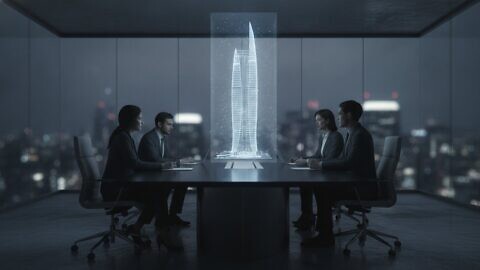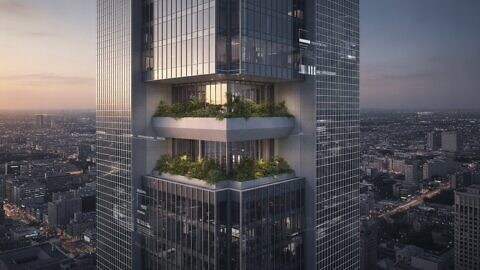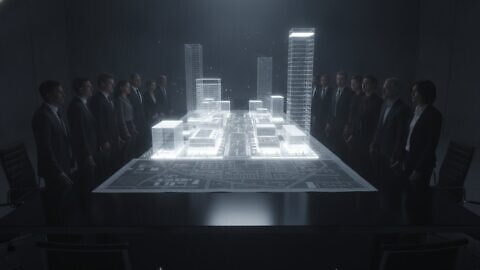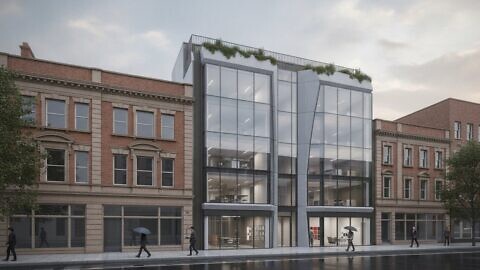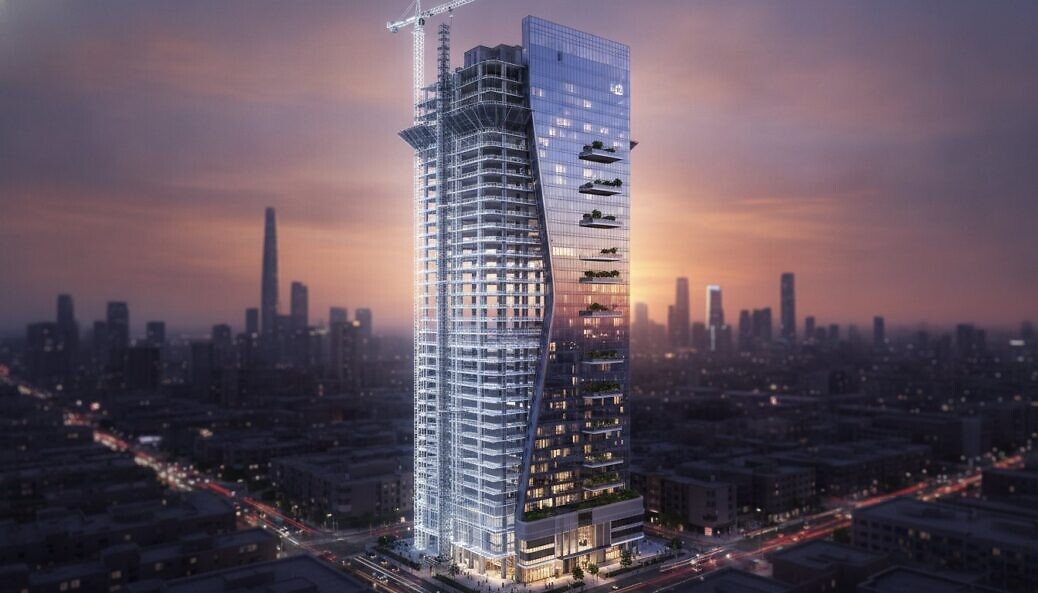
A masterfully executed project isn’t won on the construction site; it’s secured in the boardroom through the absolute elimination of doubt. You’ve likely seen how static Gantt charts and dense BIM datasets fail to convey the logistical reality of a multi-year build. This lack of clarity breeds anxiety amongst stakeholders and delays critical planning approvals whilst leaving investors feeling uncertain. By integrating CGI for construction phasing, you bridge the gap between technical complexity and visual certainty, positioning your firm as a leader in precision and foresight.
This article demonstrates how to master the strategic use of 4D CGI to communicate intricate build sequences and mitigate logistical risks before the first brick is laid. You’ll learn how to transform opaque schedules into a powerful narrative that secures stakeholder buy-in and accelerates the development timeline. We’ll explore the methodology behind high-fidelity property 3D animation, focusing on how visual clarity drives investor confidence and ensures long-term stability for your most ambitious, high-value mixed-use schemes.
Key Takeaways
- Discover how 4D visualisation bridges the gap between complex BIM data and stakeholder understanding by integrating time-based schedules into high-fidelity 3D models.
- Master the use of CGI for construction phasing to pre-emptively identify logistical clashes, reducing site risks and avoiding costly mid-build delays.
- Streamline the planning approval process by providing local authorities and communities with a clear, transparent vision of the development timeline.
- Identify the critical data points and key moments required to construct a technical framework that supports high-stakes decision-making and project precision.
- Transform technical construction programmes into compelling visual stories that build investor confidence and secure essential funding for large-scale mixed-use schemes.
Beyond the Gantt Chart: Defining CGI for Construction Phasing
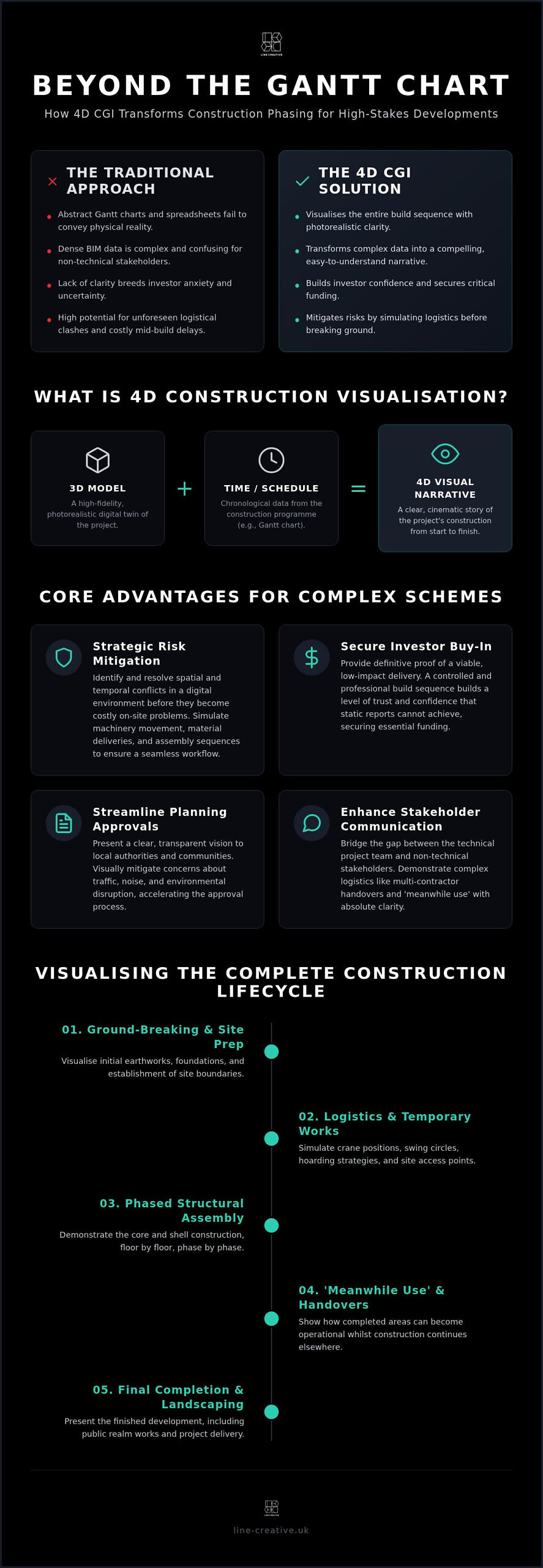
Traditional construction schedules are often confined to abstract spreadsheets and uninspired Gantt charts. Whilst these tools serve the internal project team, they fail to communicate the physical reality of a multi-phase development to those holding the capital. CGI for construction phasing integrates chronological data with three-dimensional space, creating a 4D environment where time becomes a visible asset. It transforms dry, technical datasets into a strategic narrative of progress and precision.
This shift represents a move away from simple CAD diagrams toward information-rich, photorealistic build sequences. It’s about visual storytelling for the entire construction lifecycle. By visualising the journey from ground-breaking to completion, developers can articulate their vision with a level of clarity that static documents simply cannot match. It’s a definitive safeguard against the confusion that often plagues large-scale master-planning.
The Evolution of 4D Visualisation
4D CGI has evolved from rudimentary wireframe diagrams into immersive, cinematic experiences. Modern architectural rendering allows developers to visualise temporary site works, such as hoarding and crane positions, with the same level of polish as the final building. This transition ensures that the construction site looks controlled, professional, and deliberate at every stage. Essentially, 4D CGI serves as the critical layer between technical Building Information Modeling (BIM) data and stakeholder comprehension.
Bridging the Stakeholder Communication Gap
Investors and planning officers often struggle to interpret technical architectural drawings. They need to understand the impact of construction on the local environment before committing resources or granting permissions. Using CGI for construction phasing allows you to demonstrate logistics clearly: site access points, crane swing circles, and phased hoarding strategies. There’s a profound psychological shift when a stakeholder sees a project grow realistically over time. It replaces disruption-based anxiety with a sense of inevitable success. High-end 3D rendering provides the definitive solution to the problem of information overload, ensuring every decision is backed by visual certainty.
Strategic Risk Mitigation: Why Complex Schemes Require Phasing Visualisation
Precision in planning is the only antidote to the volatility of large-scale construction. When dealing with high-stakes, multi-year developments, the cost of a logistical clash isn’t merely a delay; it’s a significant financial haemorrhage. Utilising CGI for construction phasing allows developers to identify spatial and temporal conflicts before a single excavator arrives on site. By simulating the movement of plant machinery, the delivery of materials, and the sequence of structural assembly, teams can resolve bottlenecks in a digital environment where the stakes are zero.
Securing Planning and Investor Buy-In
Local authorities and institutional investors demand more than just a finished vision; they require proof of a viable, low-impact delivery. Phasing CGI is a cornerstone of architectural visualisation for planning, providing a transparent, methodical, and evidence-based demonstration of site management. It allows you to visually mitigate concerns regarding noise pollution, traffic congestion, and environmental disruption. By presenting a highly controlled build sequence, you build a level of trust with lenders that static reports cannot achieve, proving that every risk has been anticipated and neutralised.
Logistical Clarity for Project Stakeholders
In dense urban environments, the margin for error is non-existent. CGI for construction phasing provides the definitive solution for coordinating multi-contractor handovers and complex phase transitions. It’s particularly effective for demonstrating ‘meanwhile use’, showing how public spaces or commercial units can remain operational whilst adjacent plots are under construction. This level of detail reduces the ‘fear of the unknown’ for future tenants and commercial partners, ensuring that the project remains a compelling investment throughout its entire lifecycle. If you’re managing a complex master-plan, viewing our portfolio of high-value schemes can provide clarity on how we elevate technical phasing into a strategic asset.
Integrating CGI into the Construction Programme: A Practical Framework
Integrating CGI into a live programme requires more than artistic flair; it demands a rigorous, data-driven methodology. To achieve absolute visual authority, the process must ingest Building Information Modeling (BIM) files, Primavera P6 schedules, and site logistics plans. This synthesis ensures that every frame of the CGI for construction phasing is grounded in technical truth, providing a reliable reference for lead contractors and project managers alike. A collaborative partnership between the visualisation studio and the lead contractor is the essential safeguard against failure, ensuring the digital twin evolves in lockstep with physical progress.
Successful integration depends on finding the precise balance between technical accuracy and marketing-grade aesthetic quality. Whilst the primary goal is logistical clarity, the output must also command respect in the boardroom. This requires a sophisticated approach where technical data is translated into a clean, uncluttered, and professional visual language that mirrors the excellence of the development itself.
From Data to Narrative: The Briefing Process
Translating a complex Gantt chart into a storyboard for premium 3D rendering is a strategic exercise in curation. Not every minor task requires visualisation; instead, we identify the ‘key moments’ that define the project’s trajectory. These ‘hero shots’—such as the arrival of heavy plant machinery, the completion of the structural core, or the first facade panels—transform technical milestones into a compelling story of momentum. We ensure the CGI reflects real-world site conditions, accurately depicting lighting, surrounding infrastructure, and site boundaries to provide a definitive sense of place and scale.
Maintaining Visual Authority Throughout the Build
A static visual is a historical document; a dynamic 4D model is a strategic asset. As the construction programme evolves, the CGI for construction phasing should be updated to reflect the current reality on the ground. Real-time rendering engines, such as Unreal Engine, allow for interactive phasing reviews where stakeholders can explore the timeline from any angle. This flexibility ensures that the property CGI remains relevant for both logistical planning and wider marketing campaigns. To discuss how we can transform your technical schedule into a high-stakes visual narrative, contact our London studio to speak with a strategic partner.
Line Creative: Award-Winning Visual Storytelling for High-Stakes Developments
Line Creative operates at the intersection of technical precision and cinematic artistry. We don’t just produce visuals; we craft strategic narrative bridges that transform complex engineering challenges into compelling visions of progress. For internationally recognised architects and developers, our studio serves as the essential safeguard against the ambiguity of long-term build cycles. By utilising CGI for construction phasing, we ensure that every stage of a multi-year development is communicated with absolute authority and aesthetic perfection. This level of detail is crucial when integrating the work of specialist contractors, such as the flat roofing expertise provided by Archers Roofing Services Ltd, into the visual timeline. Our ‘Story-Driven’ methodology differentiates us from standard technical studios, as we focus on the psychological impact of imagery on high-level decision-making.
Our reputation as a strategic partner is built on a foundation of trust with world-leading firms such as Zaha Hadid Architects and Olson Kundig. We’ve been recognised through multiple CGarchitect Awards, a testament to our commitment to technical and creative excellence. This global experience across the UK, Europe, and the Middle East—where we integrate high-precision geospatial data from specialists like GEOTECH 3D—allows us to turn the most ambitious architectural narratives into real visual life. We understand that for high-value schemes, the imagery must do more than just show; it must convince, inspire, and secure investment. We treat every project as a high-stakes presentation where clarity is the only acceptable outcome.
Managing the visual output for large-scale residential and commercial phasing requires a specialist CGI studio that understands the gravity of the project. We deploy disruptive technologies to ensure total project clarity, even when site constraints are at their most demanding. Our methodology is defined by a relentless pursuit of excellence, ensuring that your CGI for construction phasing is not just a technical requirement, but a powerful asset for stakeholder buy-in. We provide the definitive solution to information overload, replacing technical density with visual certainty. Elevate your next project with the studio that defines the next phase of digital creation. Contact Line Creative to discuss your next high-stakes development and ensure your vision is delivered with uncompromising clarity.
Securing the Future of Complex Development
Mastering the visual timeline of a project is no longer a luxury; it’s a strategic necessity for high-stakes urban transformation. By moving beyond the limitations of static spreadsheets and embracing CGI for construction phasing, you provide stakeholders with the definitive proof of a project’s viability. This transition from technical density to visual certainty mitigates logistical risks, accelerates planning approvals, and builds the profound investor confidence required for multi-year mixed-use schemes.
Line Creative stands as your visionary partner in this evolution. As winners of multiple CGarchitect Awards and trusted collaborators for elite firms like Zaha Hadid Architects and Aman Resorts, we bring global expertise across the UK, Europe, and the Middle East to your most ambitious projects. We don’t just render buildings; we safeguard your commercial success by ensuring every phase of the build is communicated with absolute clarity and aesthetic perfection. Partner with Line Creative for your next high-stakes development and transform your technical programme into a compelling narrative of progress. Your vision deserves the precision of an award-winning studio.
Frequently Asked Questions
What is the difference between 3D and 4D construction CGI?
3D architectural visualisation defines the physical form and material quality of a structure in three dimensions. 4D CGI for construction phasing introduces the critical fourth dimension: time. This allows developers to see the chronological progression of a build, integrating technical schedules into a spatial model. It transforms a static image into a dynamic narrative of development, enabling precise logistical planning and the early identification of site-based conflicts that 3D renders alone cannot capture.
How much detail is required for a construction phasing animation?
The level of detail depends on the project’s strategic objectives. For investor presentations, we focus on ‘hero moments’ such as structural completion or facade installation. For logistical risk mitigation, we include granular site data like crane swing circles, hoarding boundaries, and plant machinery movement. A high-fidelity sequence ensures that even temporary works look managed and professional, reflecting the uncompromising standards expected in high-value, mixed-use schemes across the UK and Europe.
Can phasing CGI be used for planning permission applications?
Phasing CGI is a powerful asset for securing planning approval, particularly for complex master-plans in dense urban environments. It provides planning officers with transparent evidence of how construction impact will be managed. By visualising the mitigation of noise, traffic, and environmental disruption, you replace administrative doubt with visual certainty. This proactive approach demonstrates a commitment to community engagement and site safety, often accelerating the approval process for high-stakes developments.
How long does it take to produce a high-quality construction sequence?
Production timelines vary based on the complexity of the build programme and the quality of the provided BIM data. A sophisticated 4D sequence typically requires several weeks to align technical schedules with photorealistic rendering. This duration ensures that the final output maintains the authoritative quality required for boardroom presentations. We work as a strategic partner to integrate your Primavera P6 or MS Project data, ensuring the digital twin remains accurate and impactful.
Is phasing CGI compatible with BIM software like Revit or ArchiCAD?
Yes, our workflow is designed to ingest data from industry-standard BIM software, including Revit and ArchiCAD. We synthesise these 3D models with time-based scheduling data to create a comprehensive 4D environment. This integration ensures that the CGI for construction phasing is grounded in technical truth rather than artistic guesswork. By using real-time engines like Unreal Engine, we can maintain a dynamic link between the architectural design and the evolving construction timeline.
Why should developers invest in phasing CGI for investor presentations?
Investors demand a definitive vision of progress and a clear strategy for risk management. Phasing CGI transforms opaque technical schedules into a compelling story of momentum and precision. It reduces the ‘fear of the unknown’ by showing exactly how a project will reach completion over a multi-year cycle. This level of visual authority builds profound trust, positioning the developer as a sophisticated operator capable of managing the gravity of large-scale, high-value developments.