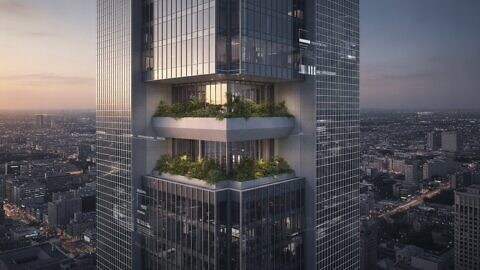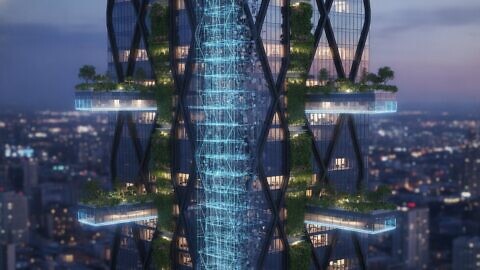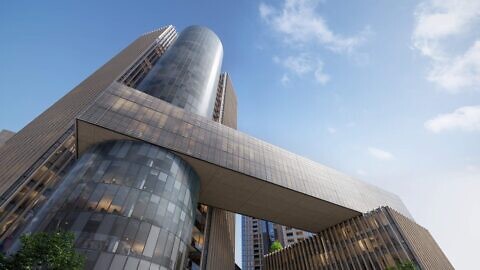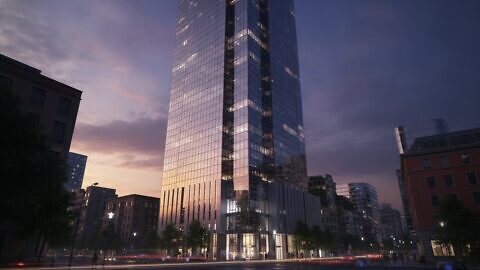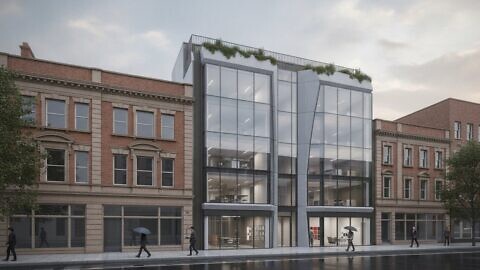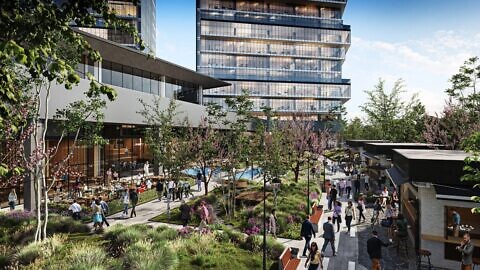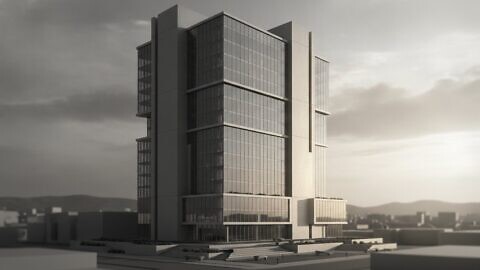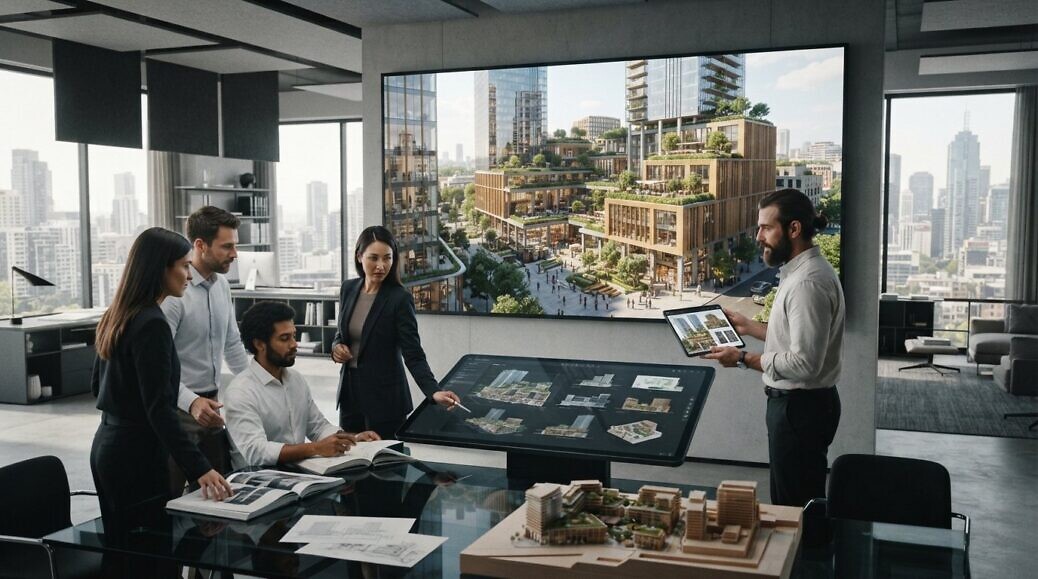
Market research across listings indicates that standard architectural rendering rates typically range between £1,500 and £2,500 per frame, with a market median of £1,850. Exact studio pricing depends on project scope, asset complexity, and required revisions, which are determined via custom quotes. Selecting the right 3D rendering studio requires evaluating technical capabilities, workflow efficiency, and clear scope definitions to secure optimal commercial value.
Key Takeaways: A professional 3D rendering studio typically charges £1,500 to £2,500 per frame, with a £1,850 market median, depending on project complexity and revisions.
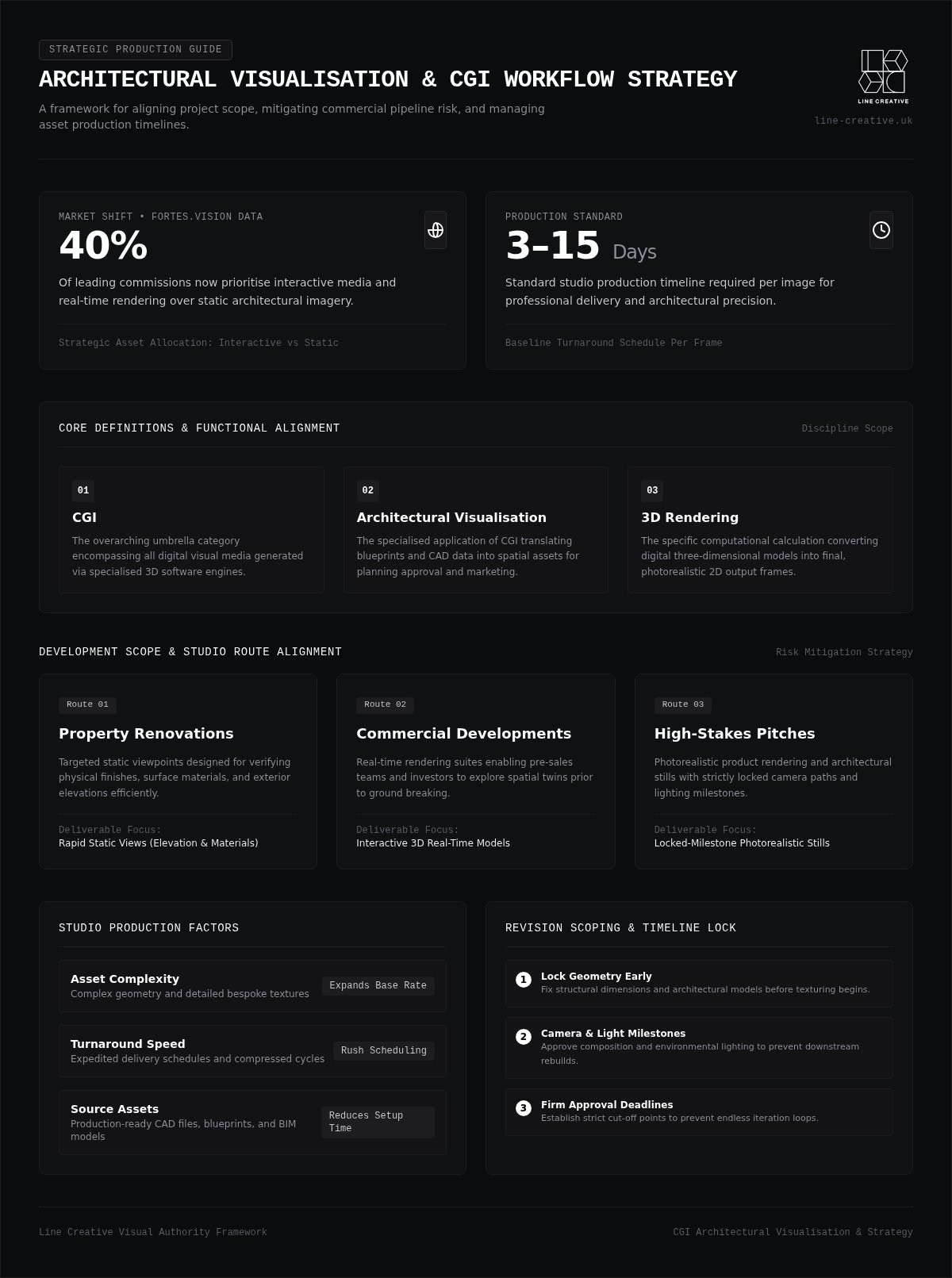
- Standard production timelines range from 3 to 15 business days per image for professional delivery.
- Skip outsourcing if you have continuous production demands and can manage internal overhead costs effectively.
- Best for property developers needing photorealistic architectural visualization to secure planning approval or investor interest.
- Fortes.Vision 2024 data shows 40% of leading commissions now prioritize interactive media over static imagery.
Match the studio route to your 2026 development risk
Choosing a suitable partner safeguards your commercial pipeline. Aligning your project scope with specialized CGI workflows mitigates financial risk before capital commitment. Single visual assets differ from complex visual packages. According to market listings, single architectural visualisations typically cost £1,500-£2,500 (market median £1,850).
Before you commit capital, map your brief to one of these routes:
- Smaller property renovations: commission rapid static views so you can approve materials and elevations without building a full interactive suite.
- Large commercial developments: specify an interactive 3D model (real-time rendering) package early, so pre-sales teams can walk investors through space before ground is broken.
- High-stakes pitches: require photorealistic stills with locked camera and lighting milestones, so presentation quality does not slip under deadline pressure.
Full spatial planning requires converted blueprints (technical drawing) alongside accurate light simulation. You can review past architectural work to see these standards in practice. Choosing comprehensive render services prevents costly design errors during construction. High-stakes pitches mandate photorealistic presentation. Line Creative delivers exact technical execution to safeguard your visual investments. Direct engagement remains the route that fits tailored project requirements. More on this: 3D Rendering Archives.
How much does 3D rendering cost?
Standard visualization pricing depends on scene complexity, revision rounds, and source assets like blueprints. The market figures above already set the public band; your quote moves inside that band when geometry, rush delivery, or missing CAD raise the workload.
Complex geometry requires extra modelling time. Investing in accurate realistic product photos (photorealistic product rendering) protects your marketing campaign from visual errors. Evaluating cost against commercial impact keeps the budget tied to outcomes you can measure. High-stakes projects demand precise digital planning to mitigate structural risks. You can explore past product work to see how technical quality dictates project scope.
| Cost Factor | Impact on Pricing |
|---|---|
| Asset Complexity | Higher detail increases base rate |
| Turnaround Speed | Fast delivery adds rush fees |
| Source Files | Ready CAD files reduce setup work |
Detailed asset preparation reduces overall turnaround time. An interactive 3D model offers wide flexibility for interactive presentations, while static imagery suits print media. Request a custom quote to get accurate pricing for your exact project requirements.
Tip: Always request a clear breakdown of draft iterations before signing to prevent unexpected scope fees based on market standards.
Lock the timeline before revisions stall your launch
Production usually requires three to fifteen business days per image. You send preliminary blueprints to the studio, expecting quick marketing assets, but unexpected revisions stall your launch.
Here is the arc that proves the point. Situation: continuous minor adjustments reset the production timeline far more than complex geometry creation, and uncontrolled revisions create a perpetual bottleneck. Action: lock geometry, camera angles, and lighting at early milestones, and set firm approval deadlines so each stage closes once. Outcome: fixing geometry early protects your schedule, and commercial campaigns stay on the print or web date you already sold internally.
For commercial campaigns, choosing static realistic product photos suits rigid print deadlines, while an interactive 3D model fits dynamic web environments. You can review product delivery examples to align your scope with actual studio delivery times.
A commenter in the nightingaledvs.com thread "Finding a Through Line, or My Creative Process Is a Mess, So…":
"Deadlines help with the issue of persistent iteration. Knowing that at 8PM on December 10th I’d be presenting these posters whether I thought they were totally done or not was helpful in guiding the final designs and choices." (source)
Establishing strict submission deadlines stops perpetual design loops and forces final asset approval. This structured timeline approach mitigates commercial delay risks for high-stakes product launches.
CGI, architectural visualisation, and 3D rendering serve different jobs
Computer-generated imagery (CGI) serves as the overarching umbrella term for all digital visual media created with specialized software.
Architectural visualization applies this technology specifically to built environments, translating architectural blueprints into precise spatial assets.
3D rendering represents the actual calculation process that produces the final 2D image from a three-dimensional digital model.
Think of CGI as the entire studio, architectural visualization as the specific film genre, and 3D rendering as the camera capturing the scene.
Understanding these distinctions protects your commercial pipeline from costly production missteps. General CGI fits broad media production, while specialized architectural visualization suits property developers who require photorealistic assets to secure planning approval.
To explore detailed industry coverage, read our latest Press feature.
Selecting the right production pathway mitigates financial risk before ground is broken.
Clear revision scoping saves capital: 4 key rules
Managing 3D rendering studio costs requires strict, transparent revision agreements before project launch. Unclear feedback loops create scope creep, which drains capital faster than initial production setup.
Cap structural change requests at the preliminary greyscale stage. Changing structural geometry after material assignment forces artists to recompute lighting paths, wasting significant project resources.
Converting preliminary blueprints into realistic product photos involves iterative refinement. You must establish strict feedback gates for these transformations. Without firm guidelines, creative anxiety often forces unnecessary project restarts. When working on an interactive 3D model, constant adjustments kill velocity. Establish hard approvals at each rendering milestone to keep momentum high and protect your capital investment. You eliminate second-guessing by securing your initial vision through structured feedback loops.
A commenter in the nightingaledvs.com thread "Finding a Through Line, or My Creative Process Is a Mess, So…":
"My creative process, whether it’s painting, writing, or data visualization, is often something like: intense work -> self doubt -> start over -> intense work -> self doubt -> start over -> intense work -> self doubt -> return to original idea with fresh eyes -> finish project." (source)
This creative cycle of constant self-doubt highlights why strict milestone approvals are essential to protect the client’s timeline and budget.
A 5-step production process that protects studio delivery
A structured CGI workflow mitigates commercial risk and ensures precise technical execution for complex visual projects. Visualising a 3D environment resembles building a high-tech watch, as every moving part relies on the accuracy of the underlying foundation. Submitting fully aligned spatial data upfront prevents costly iterations later in the pipeline.
- Data intake and analysis: You provide initial blueprints alongside spatial requirements to define project parameters.
- 3D base modelling: Specialists build high-precision geometry to secure spatial accuracy across all structural elements.
- Texturing and lighting: The studio applies realistic product photos materials and adjusts lighting to capture exact surfaces.
- Draft review: You review interactive 3D model previews to verify alignment before full computational output.
- Final delivery: Experts execute high-resolution calculations, delivering polished assets ready for commercial deployment.
Understanding this workflow helps you judge whether a partner can hold scope when pressure rises.
Among Line Creative’s Google reviews, a client specialist (5★) wrote:
"Thoroughly happy with Line Creative’s professionalism. Highly recommend them. Omer in particular was an absolute pleasure to work with."
Structured communication and dedicated contact Management remove friction during complex production cycles, which is the operational point behind that review.
When in-house architectural CGI beats outsourcing
Building internal visualization capabilities suits firms with continuous production demands and flexible submission deadlines. External rendering services sit in the same public market band already cited from listings. In-house teams eliminate recurring vendor fees for high-volume work.
Unlimited production time often creates a creative trap. Endless schedule flexibility encourages constant revisions on blueprints, delaying final sign-off. Strict agency delivery deadlines force rapid, decisive design choices that keep development moving forward. External specialists manage project pipelines with tight schedules, protecting your firm from perpetual refinement cycles.
Outsourcing fits studios seeking fast turnarounds without fixed overhead costs. Line Creative provides specialized asset creation that keeps your internal staff focused on core design priorities.
How a 3D rendering studio uses interactive media to lift marketing results
Deploying an interactive 3D model transforms passive audience interest into active commercial engagement. Line Creative builds custom digital tools tailored to specific marketing workflows.
Forty percent of leading commissions now prioritise interactive media (Fortes.Vision 2024 industry overview). Real-time rendering in Unreal Engine, paired with disciplined V-Ray asset pipelines, improves how you deploy stills and motion from one source scene. Integrating disparate applications directly secures your project data. As noted in a [CORDIS 2013 report](https://cordis.europa.eu/article/id/103573-3d-design-platform-connects-varying standard-applications/it), unifying design platforms across varying standard applications streamlines visual data transfer.
Choosing dynamic platforms over static blueprints shields your investment from early buyer fatigue. Contact our team to scale your presentation capabilities.
Frequently asked questions
How much should a 3D rendering cost?
A single project visualization typically sits in the market band already stated in the opening, according to market listings. Project complexity, resolution requirements, and tight production timelines drive final fees up or down. Request a personalized quote to get exact figures for your prospective campaign.
How much does 3D rendering cost?
Scope drives project investment, meaning detailed scenes with complex lighting cost more than basic spatial layouts. You protect capital by matching asset complexity directly to commercial objectives. Share your brief and source files to establish precise baseline pricing for your specific deliverables.
How long does a 3D rendering take?
Turnaround schedules depend on geometry complexity, revision cycles, and scene composition details. Simple realistic product photos require less production time than intricate architectural master plans based on complex blueprints. Clear project briefs eliminate delivery bottlenecks effectively.
What does a 3D rendering studio do?
A 3D rendering studio transforms two-dimensional spatial concepts and blueprints into high-impact digital assets. Line Creative builds asset pipelines that de-risk property development and product launches before physical construction begins. In fact, 40% of leading commissions now prioritise interactive media to maximize investor engagement.
What is the best 3D rendering software?
The right platform depends entirely on your specific workflow requirement and commercial output format. Production teams deploy specialized rendering engines to secure exact lighting fidelity, asset performance, and visual realism. Studio expertise matters far more than software tools.
Enhance Your Upcoming Development
Visual precision mitigates commercial risk when presenting architectural plans to stakeholders in 2026. Converting blueprints (technical drawings) into realistic product photos provides crucial clarity for prospective investors before ground is broken. Choosing dedicated 3D visualisations ensures accurate architectural detailing and spatial understanding: the same decision questions you opened with (capability, workflow discipline, and scoped revisions) still decide commercial value at the finish.
The architectural visualisation team at Line Creative brings technical expertise to complex developments. You can explore CGI solutions designed for high-stakes projects directly. View our portfolio at Line Creative London CGI Services to inspect recent work. Submit your project details today to receive a tailored quote for your 3D rendering studio requirements.