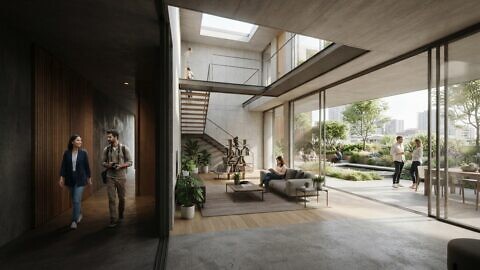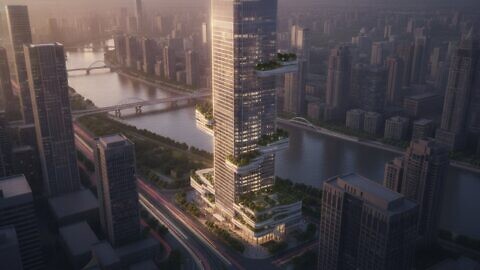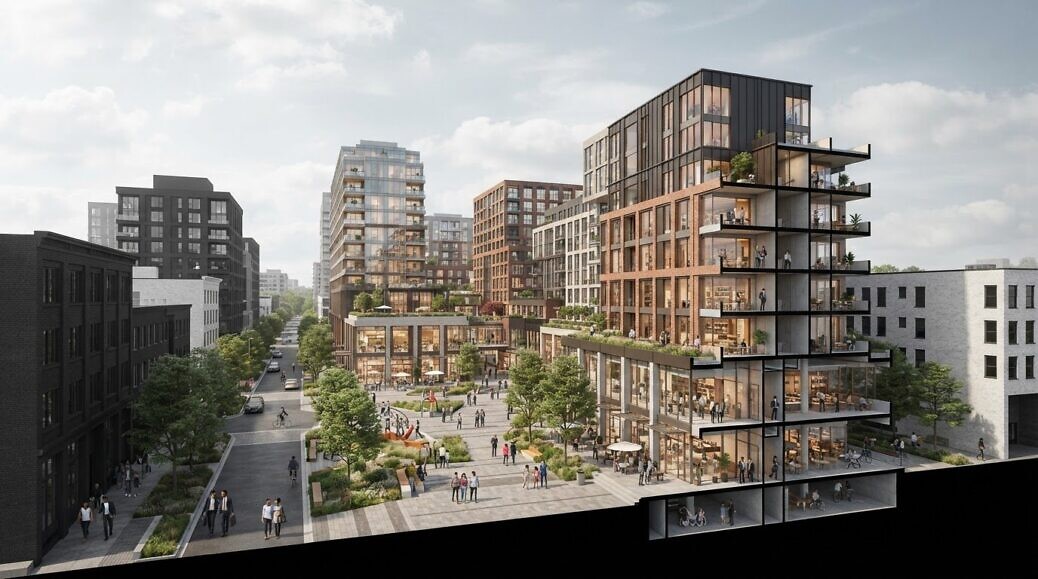
A scheme can be sound on paper and still lose support when its scale, massing or relationship to its surroundings is difficult to understand. For CGI for planning consultants, the visual gap between technical drawings and a proposal’s real-world form can create uncertainty for committees and communities.
Strong design needs more than technical detail. It also needs to be understood. Architectural visualisation can make complex proposals easier to read by showing how buildings, public spaces and surrounding streets relate. It cannot guarantee planning approval, but clear, consistent imagery can help decision-makers assess what is proposed.
This article explains how CGI can support high-value mixed-use schemes, from communicating scale and context to choosing between stills, animation and real-time rendering. It also sets out practical ways to align visual assets with the planning narrative and submission material.
Key Takeaways
- Identify where 2D drawings may leave committees uncertain, and how visual communication can address that ambiguity.
- Learn how CGI for planning consultants can clarify scale, massing and a proposal’s relationship with its surroundings.
- Discover why involving a CGI studio early can help align visual assets with the planning narrative and submission stage.
- Understand how to distinguish competition imagery from visuals prepared to communicate a proposal for planning assessment.
- Explore how an experienced CGI partner can turn ambitious concepts into compelling visual stories without presenting imagery as a guarantee of planning approval.
CGI for planning consultants: a practical visual strategy
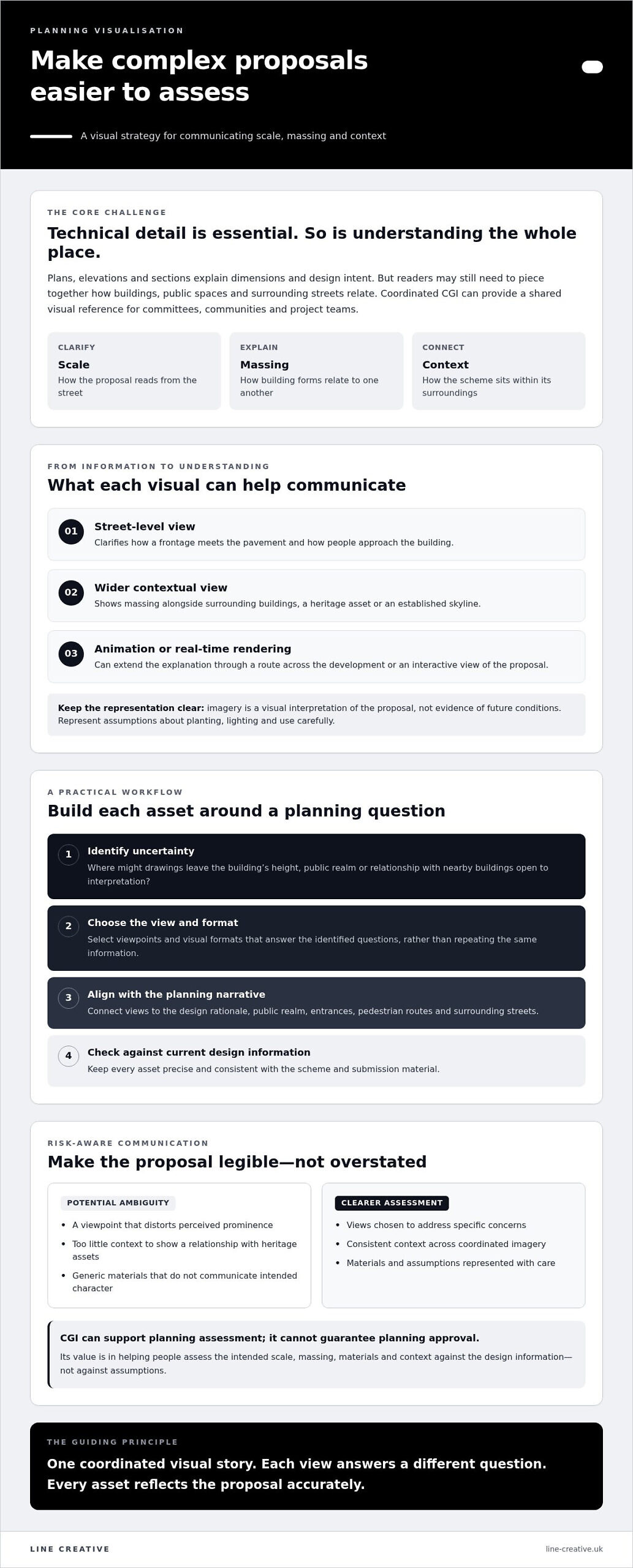
Start by listing the questions a viewer needs the imagery to answer. Is the building’s height clear from the street? Can people understand how the public realm connects to surrounding routes? Does the proposal’s relationship with nearby buildings read consistently across the drawings and visuals? Use those questions to choose viewpoints and formats, then check every asset against the current design information.
The Evolution of Planning Visualisation: Why 2D Drawings Are No Longer Sufficient
Plans, elevations and sections remain essential for communicating dimensions and design intent. But they present a scheme as separate technical views. For a high-value mixed-use development, a reader may need to piece together how a tower meets its podium, how public space connects to surrounding streets, or how the proposal sits within the existing urban fabric. The challenge is often not a lack of information, but making the relationships between those details clear.
Planning committees assess detailed submissions alongside representations from residents and other stakeholders. If scale, massing or materiality is open to interpretation, discussion can shift from the design’s merits to uncertainty about what is proposed. Clear CGI gives different audiences a shared visual reference. The wider evolution of Computer-generated imagery (CGI) includes architectural applications such as accurate 3D models and virtual walk-throughs, extending communication beyond static technical views.
Bridging the Gap Between Architect and Layperson
Design intent may involve complex geometry, layered uses and carefully composed public spaces. A stakeholder without architectural training may not readily infer those qualities from drawings alone. CGI for planning consultants can translate them into a human-scale narrative, showing how people approach a building, move through shared areas and experience its relationship with neighbouring streets. This gives people clearer material to discuss, question and assess.
The High Cost of Visual Ambiguity
A poorly chosen viewpoint can distort perception even when the design itself is precise. An isolated image may make a building appear unusually prominent; too little context may hide its relationship to heritage assets; generic materials may misrepresent the intended character. These gaps can lead to requests for clarification or further visual material, adding work and uncertainty to the process.
For a sensitive site or a scheme under public scrutiny, photorealistic CGI is a communication and risk-management tool, not a guarantee of planning approval. Its value lies in showing the proposal’s scale, massing, materials and context clearly, so concerns can be considered against the intended design rather than assumptions. Treat each view as part of a broader planning narrative: precise, consistent and based on the scheme’s actual design information.
CGI as a Risk Mitigation Tool: Communicating Scale, Massing, and Context
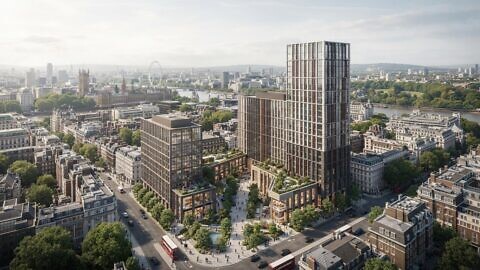
For a complex masterplan, a useful image must do more than make the proposal look attractive. It should show how different uses, buildings and public spaces work together, and how each element relates to its surroundings. CGI for planning consultants can make those relationships legible through coordinated views that retain architectural precision while presenting the scheme as a connected place.
Choose viewpoints to answer specific questions. A street-level view can clarify how a frontage meets the pavement; a wider view can show the massing alongside a heritage asset or established skyline. Animation can extend that explanation by following a route through the development or showing how the design reads in different lighting conditions. These are visual interpretations of the proposal, not evidence of future conditions, so represent assumptions about planting, lighting and use carefully.
Strategic Narrative Control in Planning
Story-led visuals can direct attention to the design rationale and public realm, not just the building form. If the proposal includes green space, pedestrian connections or infrastructure, show how these relate to entrances, routes and surrounding streets. Consider likely points of concern, then select views that address them directly. This approach to architectural visualisation for mixed-use planning can balance the wider masterplan with the detail stakeholders need to assess individual spaces.
CGI can also support discussion across a project team. As Designing Buildings Wiki explains, CGI can help discuss designs with stakeholders, making visual material useful beyond a final presentation. Plan a sequence in which each view answers a different planning question instead of repeating the same impression.
Visualising Design Intent and Community Impact
Where they form part of the proposal, green roofs, solar integration and pedestrian-friendly zones can be depicted to communicate design intent. Visuals can also illustrate how shared spaces are intended to be used, helping stakeholders understand the proposed experience of a mixed-use environment. They should not be treated as proof of environmental performance or technical compliance. Pair them with the relevant project information and assessments.
Material response matters, too. Carefully rendered surfaces and lighting can help explain how a palette is intended to sit within its setting and how façades may read in different conditions. For an ambitious scheme, this context can help decision-makers assess the proposal as a considered place rather than an abstract collection of forms.
Integrating High-End Visuals into the Planning Workflow: A Consultant’s Framework
Bring a CGI studio into the conversation while the design and planning narrative are still taking shape. Early collaboration gives you time to identify the questions visuals need to answer, agree which views will support the submission and keep imagery aligned with evolving design information. For high-value schemes, CGI for planning consultants is most effective when it supports a defined communication strategy, rather than being added as a final presentation layer.
Competition imagery and planning visuals have different priorities. A competition image may lead with atmosphere or a bold design idea; planning material needs to communicate the proposal clearly and consistently with the drawings and supporting documents. Set review stages with the architect, planning team and CGI studio. Check camera positions, massing, materials and landscape against current design information, and confirm that revisions are reflected across the relevant visuals. Core imagery may also support investor presentations, but adapt its emphasis without creating conflicting versions of the scheme.
Keep the narrative grounded in design quality, context and character. The government’s National Design Guide offers a reference point for these considerations. Align CGI with the planning statement and design and access statement, so each view supports rather than contradicts the written case.
The Role of Real-Time Rendering and Virtual Production
Real-time rendering can support visual iteration when the model and workflow are set up for it. With a suitable Unreal Engine scene, a team may explore a proposed change during a review and see its visual effect, subject to the model’s detail and agreed technical process. This does not replace controlled design sign-off. Explore virtual production and AR/VR if an interactive format could help stakeholders understand spatial relationships beyond a fixed viewpoint.
Documenting the Vision: Stills vs. Animation
Use a still when one carefully chosen view can explain a key frontage, public space or relationship with the surroundings. Choose animation when movement is central to the story, for example, to explain a pedestrian route through a masterplan or show how different uses connect. Keep the sequence purposeful and consistent with the project information. Motion can clarify intended routes, but should not imply verified traffic or operational outcomes.
For a project-specific discussion of CGI within your planning workflow, contact Line Creative.
Partnering with an Award-Winning Studio: Securing Consent through Story-Driven CGI
Your CGI partner influences how clearly a proposal is communicated, but visual pedigree alone cannot secure planning approval. The value comes from combining technical discipline with the creative judgement to present a complex scheme accurately, consistently and with a compelling narrative. For CGI for planning consultants, look for a studio able to understand the planning context as well as the architectural intent.
Line Creative has received multiple CGarchitect Awards and has worked on projects for internationally recognised practices including Zaha Hadid Architects and Olson Kundig. Its architectural CGI portfolio includes work across complex property and international development projects. Awards and client experience can indicate creative and technical capability, but they do not replace accuracy or project-specific evidence in a submission.
A Collaborative Mindset for Ambitious Projects
A strong studio relationship starts with shared objectives. Align the CGI team with the architect’s design intent and your planning narrative, then establish clear review points for geometry, materials, context and viewpoints. This helps identify discrepancies before the visuals are presented to stakeholders. Creative flair matters, but it must sit alongside architectural precision. The aim is imagery that gives an ambitious proposal real visual life without overstating what the design documents support.
Consistent collaboration can also make visual communication more coherent across project stages. A studio that understands the scheme’s wider context can help maintain a considered narrative as the material develops, while keeping each image appropriate to its purpose.
From Planning Communication to Marketing
Some CGI stills or animation may have a further role after a planning decision, supporting property communication or investor presentations. Planning imagery is not automatically ready for marketing: the design, audience and required content may change. Confirm intended uses and technical specifications at the outset, then review assets against the approved design before reusing them. This can support continuity across communications without assuming a particular commercial return or sales outcome.
Line Creative provides architectural visualisation, 3D rendering and CGI animation for property projects. To discuss the visual requirements of your next high-stakes planning application, contact Line Creative.
Make Your Next Planning Submission Clearer and Stronger
For complex, high-value schemes, visual communication is part of the planning strategy. CGI for planning consultants can make scale, massing and context easier to assess, while carefully planned stills and animation help keep the visual narrative aligned with the design and supporting documents. It can reduce ambiguity, but it cannot guarantee planning approval.
The right studio brings more than image-making. Line Creative specialises in complex mixed-use schemes and has received multiple CGarchitect Awards. Its work for firms such as Zaha Hadid Architects reflects experience communicating ambitious architectural proposals with technical precision and creative purpose.
Choose a visual partner who understands the project’s requirements and can work alongside your team. Discuss your next high-stakes planning application with Line Creative. A clear, considered visual story can help decision-makers engage with the proposal on its merits.
Frequently Asked Questions
How does CGI help in the planning permission process for mixed-use developments?
CGI helps communicate how a mixed-use proposal’s buildings, uses and public spaces fit together. For planning consultants, it can make scale, massing, materials and relationships with surrounding streets easier for committees and communities to assess. A sequence of carefully selected stills or animation can explain different viewpoints and routes through the scheme. CGI supports clear communication, but it cannot guarantee planning approval or replace drawings and other supporting information.
What is the difference between a standard render and a CGI for planning application?
There is no separate CGI format that automatically makes an image suitable for a planning application. The difference is its purpose and how closely it represents the current proposal. A marketing render may prioritise atmosphere, while planning visuals should communicate design, scale and context clearly and consistently with project information. Agree viewpoints, design details and intended use with your project team, and check that the imagery does not imply features that are not part of the proposal.
At what stage of the planning process should we engage a CGI studio?
Engage a CGI studio early enough to shape the visual approach before submission material is finalised. At concept or pre-application stages, identify which views will clarify the scheme and what design information the studio needs. As the proposal develops, set review points with the architect and planning team to check that the visuals reflect current geometry, materials and context. Early coordination can reduce the risk of late changes leaving imagery out of step with the submission.
Can CGI animation be used to address community concerns during public consultations?
Yes. CGI animation can help explain how a proposal is intended to be experienced, such as how people move between public spaces or how different uses connect. It can give consultation audiences a clearer view of a scheme than plans alone, provided the sequence is accurate and tied to the design information. Use animation to respond to specific questions, not to imply verified traffic patterns, environmental performance or future outcomes that the visuals cannot establish.
How long does it typically take to produce high-quality CGI for a planning submission?
There is no single reliable production timeframe. It depends on the scope, model readiness, number and complexity of views, whether animation is required, and the review process. Design changes can also affect the schedule. Before work begins, agree the required assets, technical specifications, information handover dates and feedback stages with your CGI studio. This helps the project team plan around the actual brief rather than rely on a generic turnaround estimate.
Does Line Creative provide Verified View Montages for planning?
No. Line Creative does not provide Verified View Montages (VVMs). The studio provides CGI animation, 3D rendering and architectural visualisation to support planning communication, but these services are not a substitute for a verified visual product. If your application requires VVMs, confirm the necessary scope and methodology with the relevant planning team and appoint a specialist provider for that work. Keep responsibilities clear so each visual asset is correctly described and used.